The Spider’s Thread: A Japanese Folklore Brought to Life Through Irezumi
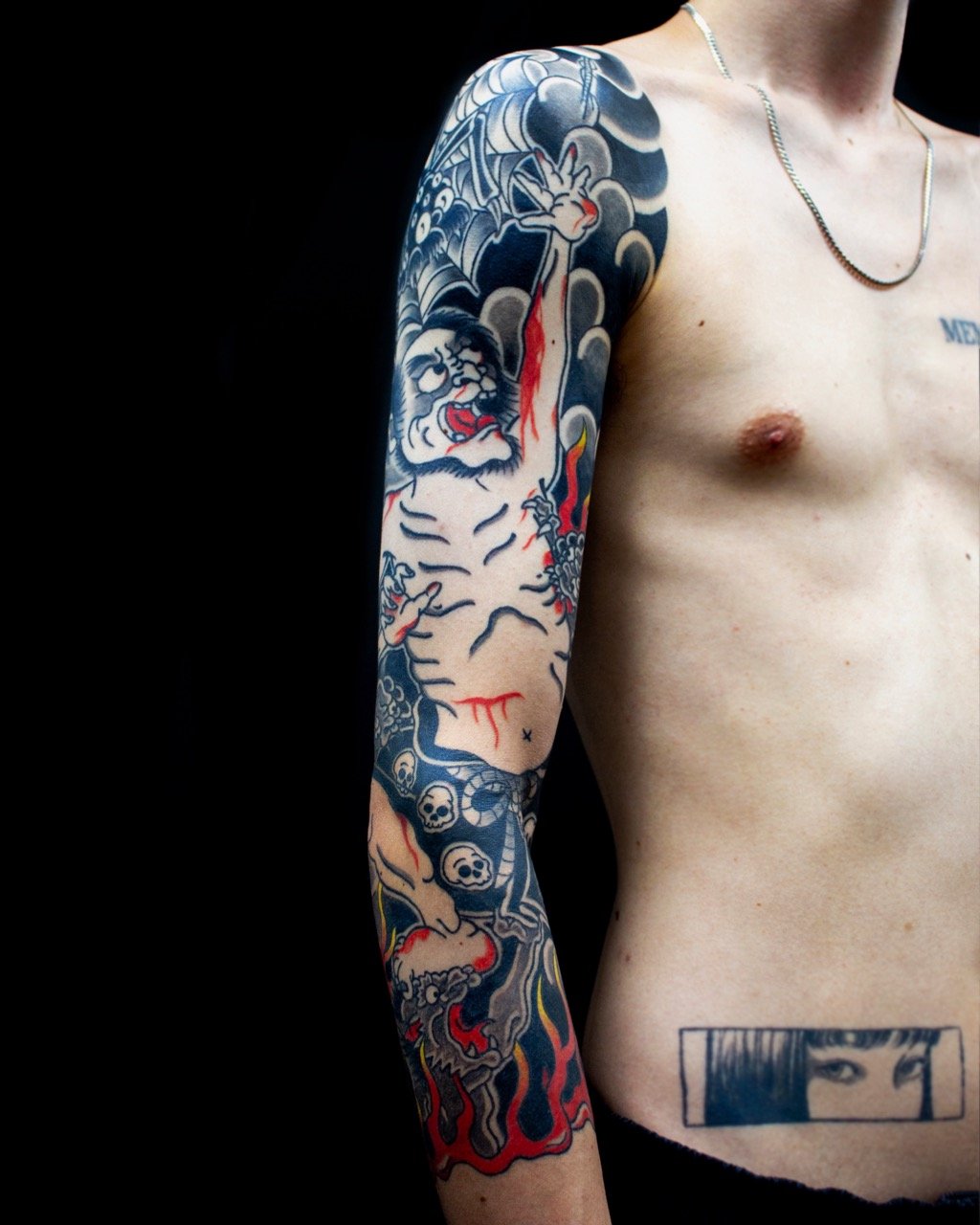
A Japanese folklore sleeve inspired by The Spider’s Thread (蜘蛛の糸), bringing a childhood story to life through oni, dark clouds and flames. Japanese sleeve done by Horiyama. Auckland, New Zealand.
This sleeve was a little different from my usual subject matter, and I’m incredibly stoked with how it turned out.
Created for Andrew, who is half Japanese, this custom Japanese tattoo sleeve is based on The Spider’s Thread (蜘蛛の糸, Kumo no Ito), a Japanese story that his father used to read to him as a child. It was a story I knew well myself, having grown up hearing it back in Japan.
There was something really special about being able to work on a piece that connected us through a story we both grew up with. Rather than simply choosing traditional Japanese tattoo imagery, we had a narrative that meant something to both of us, giving the sleeve a deeper layer of personal significance.
The challenge was to translate that story into a Japanese tattoo sleeve, using traditional imagery, strong composition and my own interpretation to bring the scene to life on the body.
The Story Behind The Spider’s Thread
Written by Japanese author Ryūnosuke Akutagawa in 1918, The Spider’s Thread is a well-known Japanese literary tale about a criminal named Kandata, who finds himself suffering in hell.
Despite his cruel life, Kandata had once shown a small moment of kindness by sparing the life of a spider. Seeing this, Buddha decides to give him a chance at redemption.
Buddha lowers a single spider’s thread from paradise into hell. Kandata notices it and begins climbing, desperately trying to escape his suffering and reach salvation.
But as he climbs, he looks down and sees countless other souls following him up the same thread. Afraid that they will escape alongside him, he selfishly shouts for them to let go because the thread belongs to him alone.
At that moment, the thread snaps, and Kandata falls back into hell.
His chance at redemption is lost.
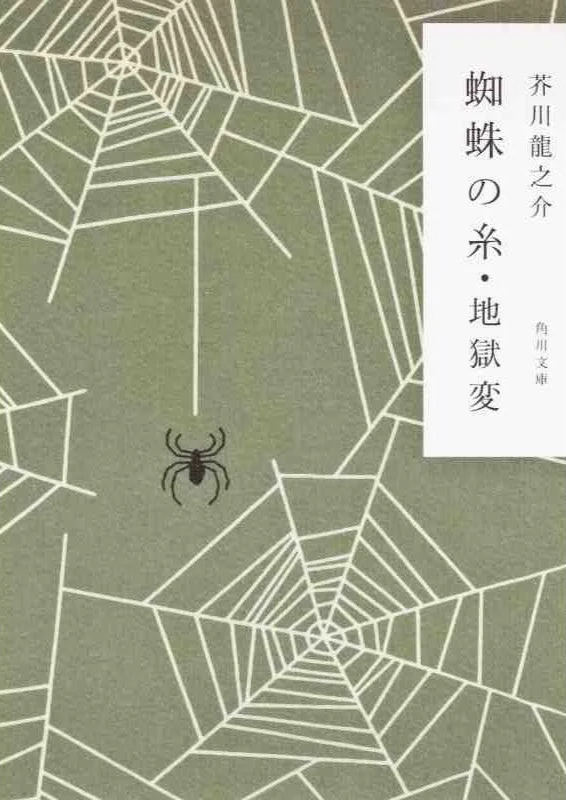
The original Japanese story, The Spider’s Thread (蜘蛛の糸), by Ryūnosuke Akutagawa — a tale of hope, redemption and the consequences of selfishness.
The Deeper Meaning Behind the Story
What makes The Spider’s Thread such a powerful story is that it explores the relationship between compassion, selfishness and human nature.
Kandata is given an opportunity to escape his suffering because of one small act of kindness. However, when faced with the possibility of sharing that opportunity with others, his selfishness takes over.
The story raises an interesting question: is someone truly capable of redemption if they cannot show compassion towards others?
The spider’s thread represents hope, a second chance and the possibility of salvation. Yet the thread is fragile, and Kandata’s own actions ultimately destroy his chance to escape.
For me, this was what made the story such an interesting subject for a tattoo. It isn’t simply a depiction of hell or a figure trying to escape it. There is a deeper narrative about the choices we make, the way we treat others and how easily selfishness can undo an opportunity for change.
These themes gave us plenty to work with when developing the visual direction of the sleeve.
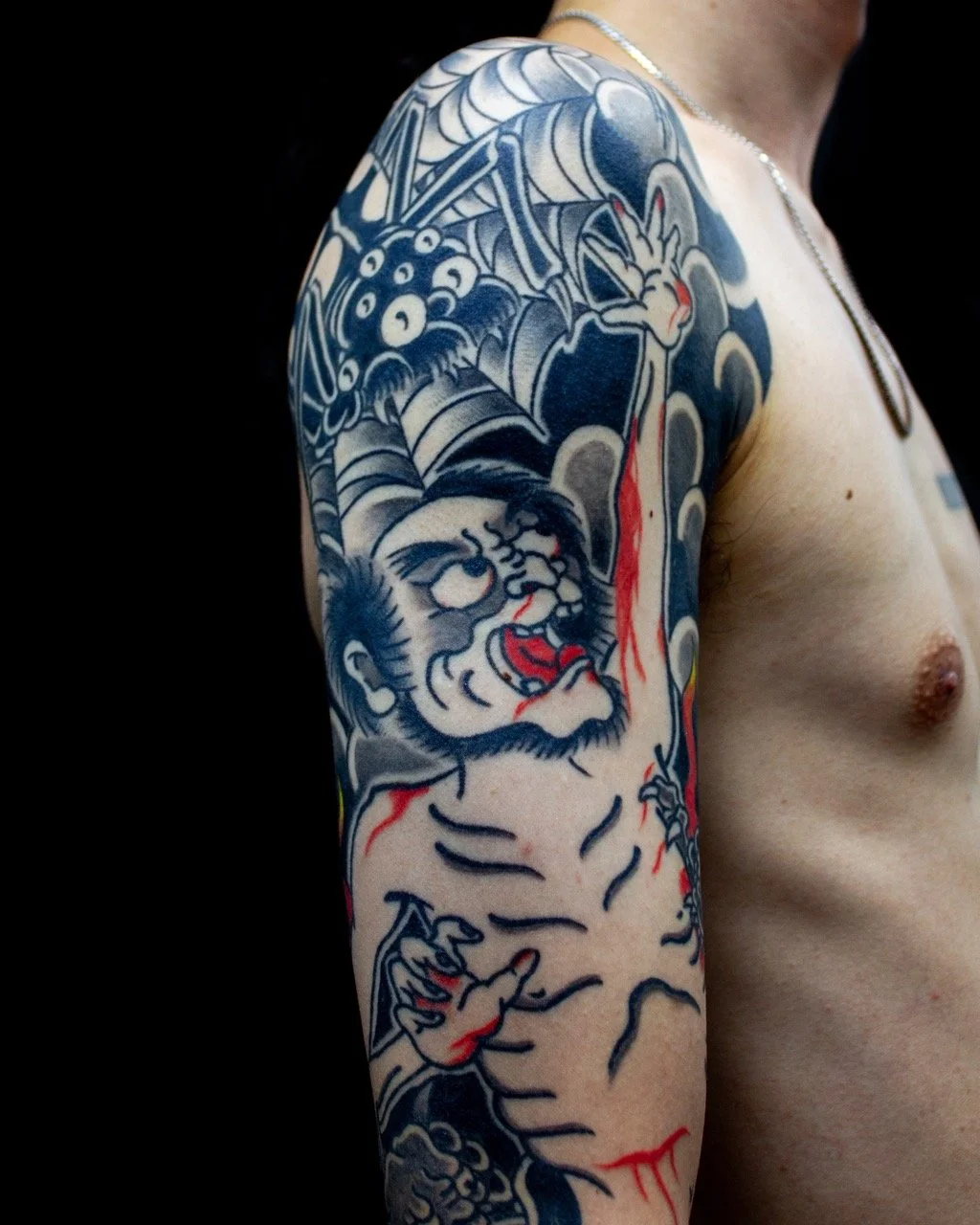
The central figure reaches towards the spider’s thread, his final chance to escape hell.
Translating the Story Into a Japanese Tattoo Sleeve
One of the most interesting parts of this project was finding ways to represent the story through Japanese tattoo imagery while making the composition work as a complete sleeve.
Rather than illustrating every moment literally, I focused on the key elements that would communicate the atmosphere of the story and its setting.
The figure reaching for the spider’s thread
At the top of the sleeve, the figure reaches upwards towards the spider’s thread, representing Kandata’s attempt to escape hell.
The placement of the thread was important. It needed to sit high on the arm, giving the figure a clear direction to reach towards and creating a visual connection between the character and the spider above.
The spider itself sits at the top of the sleeve, completing this part of the narrative and connecting the tattoo directly to the story’s central symbol of hope and redemption.
Oni demons surrounding the figure
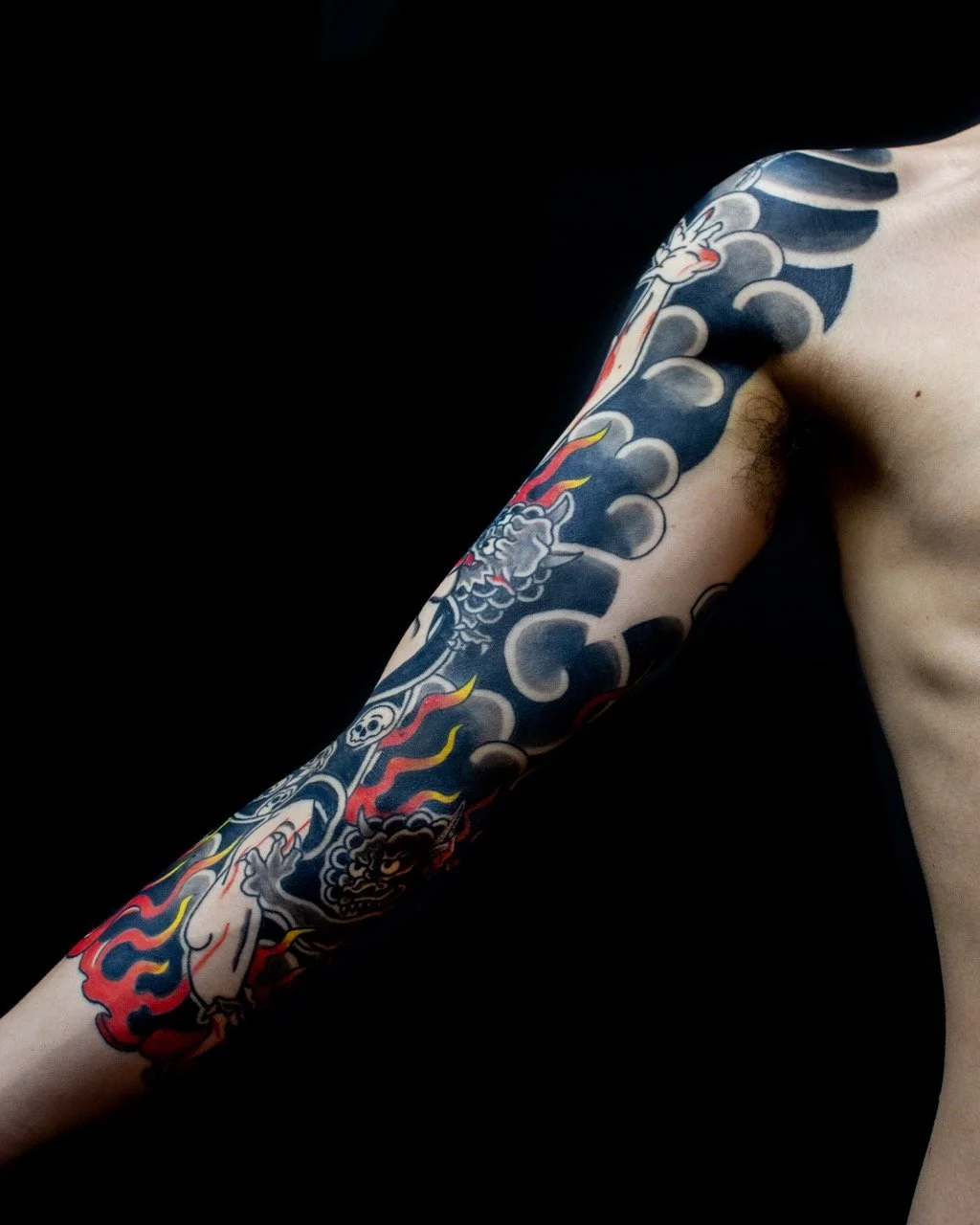
The oni demons surrounding the central figure help establish the setting of hell. In Japanese folklore and traditional tattoo imagery, oni are powerful supernatural beings often associated with punishment, danger and the underworld.
Their presence creates a sense of menace around the figure, making his attempt to climb towards salvation feel even more desperate.
I wanted the surrounding imagery to frame the central character while maintaining the movement and flow needed for a successful Japanese sleeve.
A gaunt figure and skull-patterned clothing
Andrew’s suggestion was to keep the central figure very skinny and gaunt to emphasise his condition in hell. His body needed to feel vulnerable and almost skeletal against the heavier, darker imagery surrounding him.
The skulls incorporated into his clothing reinforce the atmosphere of death and suffering, helping to establish the environment without relying entirely on the demons and background.
These details also give the sleeve more to discover when viewed up close, while contributing to the overall narrative.
Flames instead of traditional mikiri bars
One of the biggest departures from my usual approach was how I finished the bottom of the sleeve.
Traditional Japanese sleeves often use mikiri — the finishing edges that help define the boundaries of the tattoo — to create a clean, deliberate finish.
For this piece, I decided to do something different.
Rather than finishing the sleeve with traditional mikiri bars, I used flames to represent hell. The flames create a more dramatic ending to the composition, reinforcing the environment the figure is trapped in and allowing the imagery to flow naturally towards the wrist.
It was a conscious decision to let the subject matter influence the finish rather than follow my usual approach. I think this helped the sleeve feel more connected to the story as a whole.
A Custom Japanese Tattoo With a Personal Story
What I love about Japanese tattooing is how much can be communicated through the relationship between the subject, the background and the overall composition.
Every element needs to work together. The main figure, the oni, the spider, the thread, the skulls and the flames each have their own role, but they also need to form one cohesive design that follows the shape of the arm.
This project gave me the opportunity to explore a subject outside my usual choices while still approaching it through the principles of Japanese tattooing that I love: strong composition, balance, movement and clarity.
I’m incredibly happy with how this sleeve turned out. Andrew was an amazing client, and we completed the entire sleeve in just four full-day tattoo sessions.
More than anything, I’m grateful for the opportunity to create a piece based on a Japanese story that we both grew up with. Being able to take something familiar from childhood and reinterpret it as a large-scale Japanese tattoo made this project particularly rewarding.
Thank you Andrew, for trusting me with this one.
Looking for a Japanese Tattoo Artist in Auckland?
I specialise in Japanese tattooing, from smaller one-point pieces to large-scale projects such as sleeves, backpieces and bodysuits.
Whether you have a specific Japanese folktale, mythological figure or traditional tattoo subject in mind, or you’re looking to develop a completely custom design, I enjoy working with clients to create tattoos with thoughtful composition and a strong visual identity.
If you’re considering a Japanese tattoo sleeve in Auckland, you’re welcome to get in touch to discuss your ideas.
View my work and enquire about a custom Japanese tattoo at horiyama.co.nz.
Thank you for reading.