Namikiri Chōjun (波切張順), also known as Rōri Hakuchō Chōjun (浪裡白跳張順), is one of the 108 heroes of the Suikoden and a well-known subject in traditional Japanese tattooing.
He is particularly recognisable for his connection with water. Some of the most striking ukiyo-e depictions show Chōjun fighting through the water, including the famous scene of him breaking through a water gate with a sword clenched between his teeth while arrows fly around him.
It is an incredibly dynamic subject and one that lends itself naturally to a large traditional Japanese back piece.
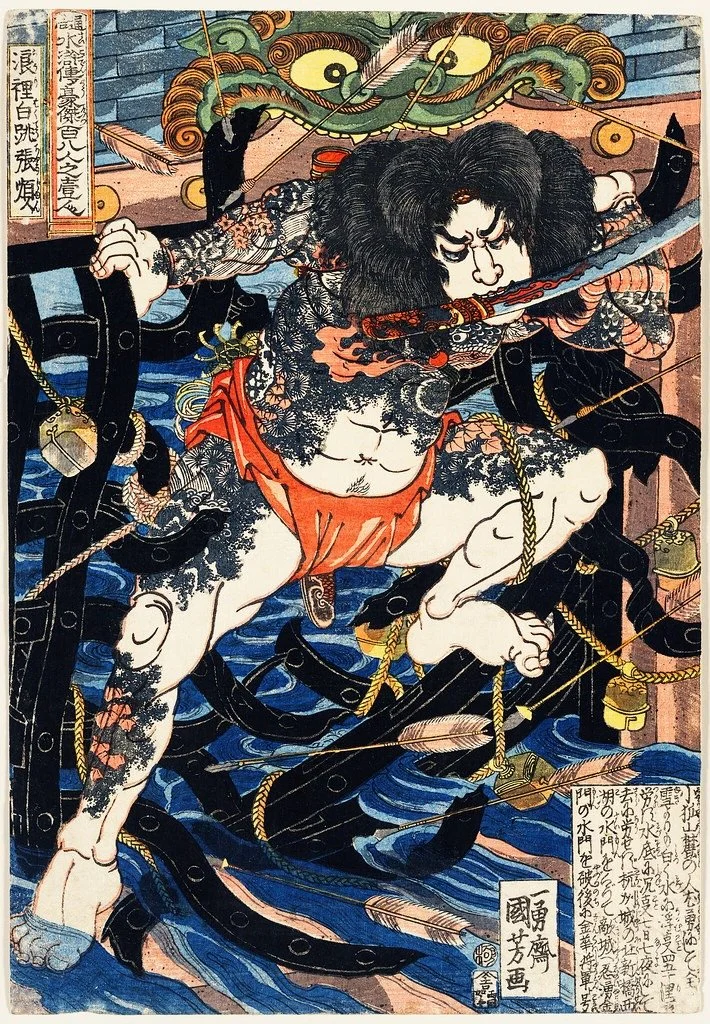
Rōri Hakuchō Chōjun breaking through the water gate, Utagawa Kuniyoshi, c. 1827-1830. From the series One Hundred and Eight Heroes of the Popular Suikoden.
Who is Namikiri Chōjun?
Chōjun is the Japanese interpretation of Zhang Shun, one of the heroes of the Chinese novel Water Margin, which became known in Japan as the Suikoden.
The Suikoden tells the stories of 108 heroes, many of whom became hugely popular subjects for ukiyo-e artists during the Edo period. Their dramatic personalities, battles and distinctive appearances gave artists endless opportunities to create powerful and imaginative compositions.
Chōjun was particularly famous for his ability in the water. His name Namikiri can be translated as “cutting through the waves”, while his other nickname, Rōri Hakuchō, is associated with his exceptional ability as a swimmer.
Water is therefore not simply a background added to images of Chōjun. It is an important part of his character.
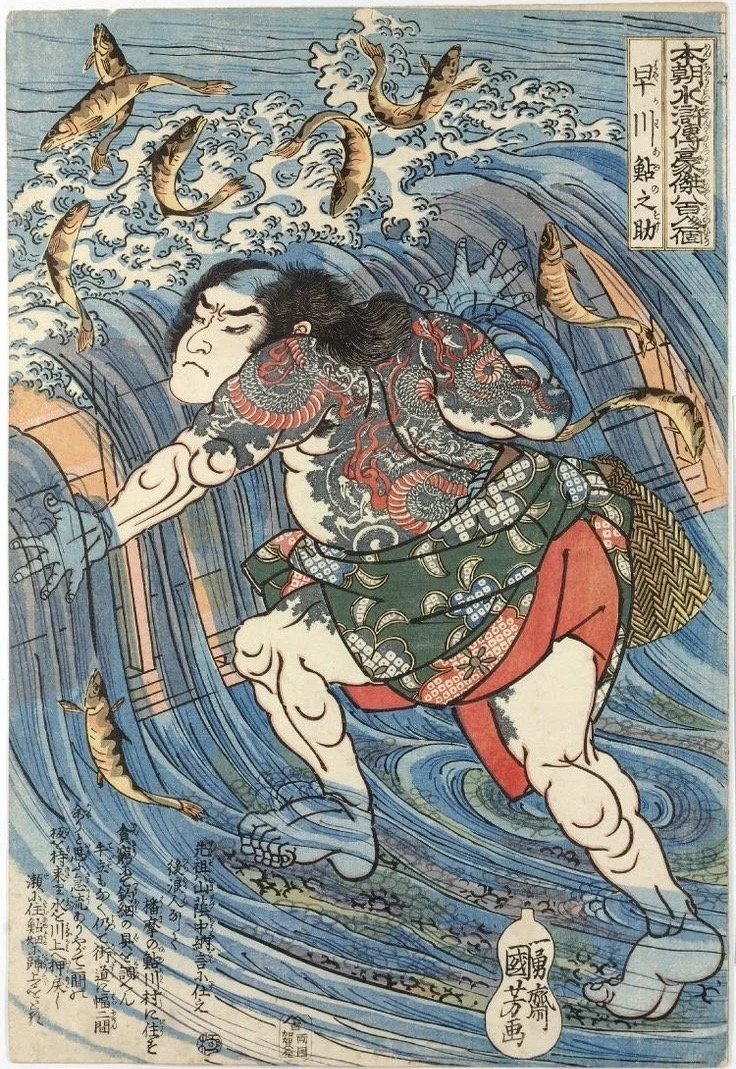
Rōrihakuchō Chōjun standing in water, Tsukioka Yoshitoshi, 1868. From the series Strong Heroes of the Water Margin
Chōjun in ukiyo-e
Namikiri Chōjun appears in numerous ukiyo-e prints, with artists portraying him in a variety of dramatic scenes.
He became particularly associated with powerful images of movement through water. The famous water-gate scene depicts Chōjun forcing his way through the gate with a sword in his mouth while surrounded by arrows and rushing water.
Other compositions show him moving through waves with his sword, creating a very different but equally dynamic image.
The popularity of these prints reflects what made the Suikoden heroes so appealing to ukiyo-e artists. They offered recognisable characters, dramatic stories and plenty of opportunity for exaggerated movement, strong poses and elaborate backgrounds.
Chōjun had all of these qualities with the added visual advantage of water.
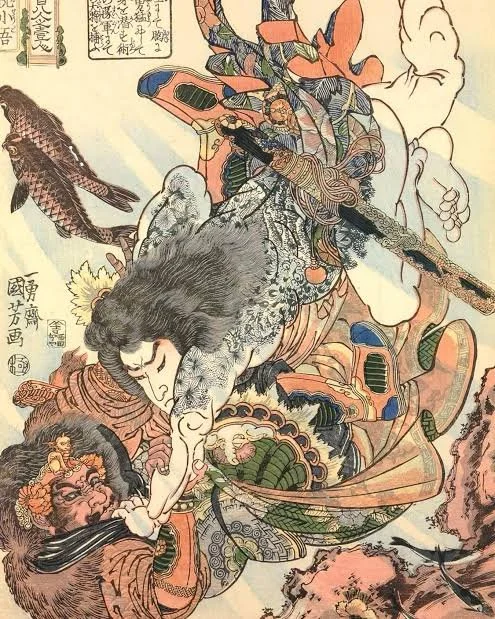
Rōrihakuchō Chōjun wrestling with Kokusenpū Riki underwater, Tsukioka Yoshitoshi, 1887.
Why water works so well with Chōjun
Water is one of the most versatile background elements in traditional Japanese tattooing, and Chōjun is a perfect example of why.
The waves can be energetic and heavily stylised, or they can be used more subtly to frame the figure. They can move around the body, create direction through the composition and help connect the subject to the shape of the back.
With Chōjun, the relationship between the figure and the background feels particularly natural because water is already fundamental to his story.
The water gate composition is especially strong for a back piece. The gate, waves, arrows and figure can all be arranged to create a sense of movement across the body, while the sword between his teeth gives the central figure a strong and immediately recognisable focal point.
The alternative compositions of Chōjun moving through the waves can be equally effective, particularly when the water is allowed to become a major part of the overall design.
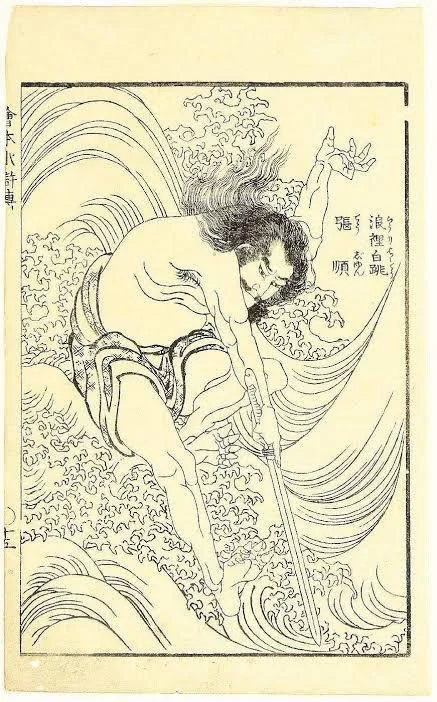
Rōri Hakuchō Chōjun, from Chūgi Suikoden Ehon, Katsushika Hokusai, 1829.
A classic Japanese tattoo subjecT
Namikiri Chōjun has remained a popular subject for traditional Japanese back pieces, and his dramatic imagery has translated beautifully from ukiyo-e into irezumi. His different depictions offer plenty of possibilities for interpretation, from the iconic water-gate scene to compositions of Chōjun moving through the waves.
For me, this makes him an especially enjoyable subject to design. There is enough history and established imagery to keep the tattoo rooted in tradition, while still leaving room to create a composition that is unique to the individual.
If you are considering a Namikiri Chōjun Japanese tattoo, a Suikoden back piece, or another traditional Japanese tattoo, get in touch to discuss your ideas and start planning a piece designed specifically for you.