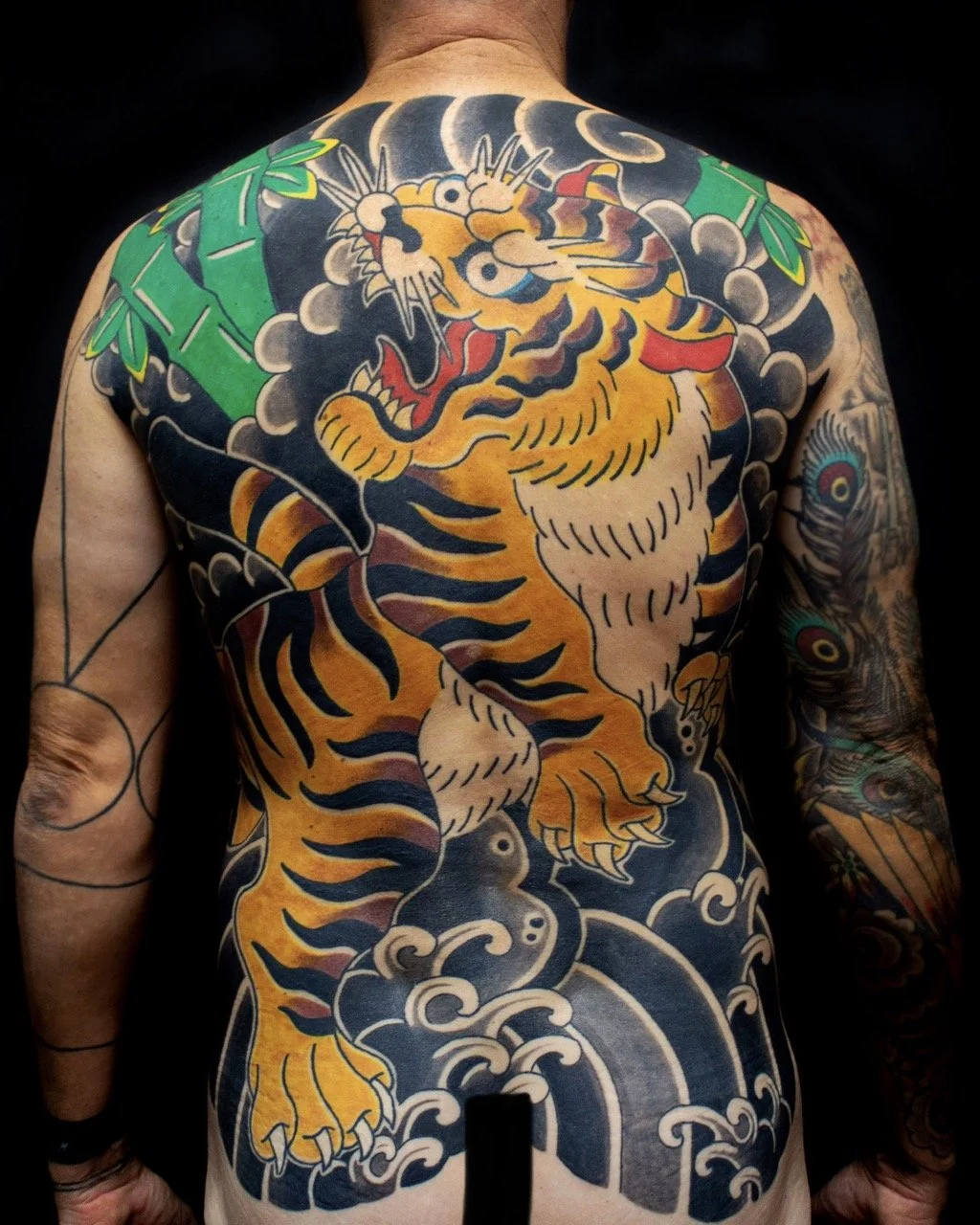
Japanese tiger and bamboo backpiece with traditional cloud, wind and water background.
This Japanese backpiece features a tiger climbing through rocks, surrounded by bamboo, clouds, wind and water. The composition is based on classic Japanese tattoo imagery, with the tiger as the main subject and the background used to create movement, depth and a sense of flow across the body.
The tiger is one of the most recognisable subjects in Japanese tattooing, and the combination of tiger and bamboo has a long history in Japanese art.
The meaning of the tiger in Japanese tattooing
The tiger has traditionally been associated with strength, power, courage and protection. In East Asian art, it is also considered an auspicious and powerful animal, with a long history as a guardian figure.
Japanese depictions of tigers are particularly interesting because they are often shown with a mixture of power and character rather than simply as an aggressive animal. The tiger can appear alert, watchful and commanding, with its posture and expression contributing as much to the image as its physical strength.
In this backpiece, the tiger is shown in a classic climbing pose, moving over rocks and water with its body angled through the composition. This gives the subject a strong sense of movement while allowing the body of the tiger to follow the natural shape of the back.
The meaning of bamboo
Bamboo has its own long-standing symbolism in Japanese art. It is admired for its strength, resilience and ability to bend without breaking. Its hardiness and ability to withstand difficult weather have made it a longstanding symbol of endurance, perseverance and steadfastness.
Bamboo is also one of the traditional Three Friends of Winter, alongside pine and plum, which are associated with resilience and perseverance.
In tattooing, bamboo also works beautifully as a visual element. Its long, vertical stems and leaves can frame a figure without competing with it, while giving the composition direction and rhythm. It helps give bursts of colour amongst the dark bold background.
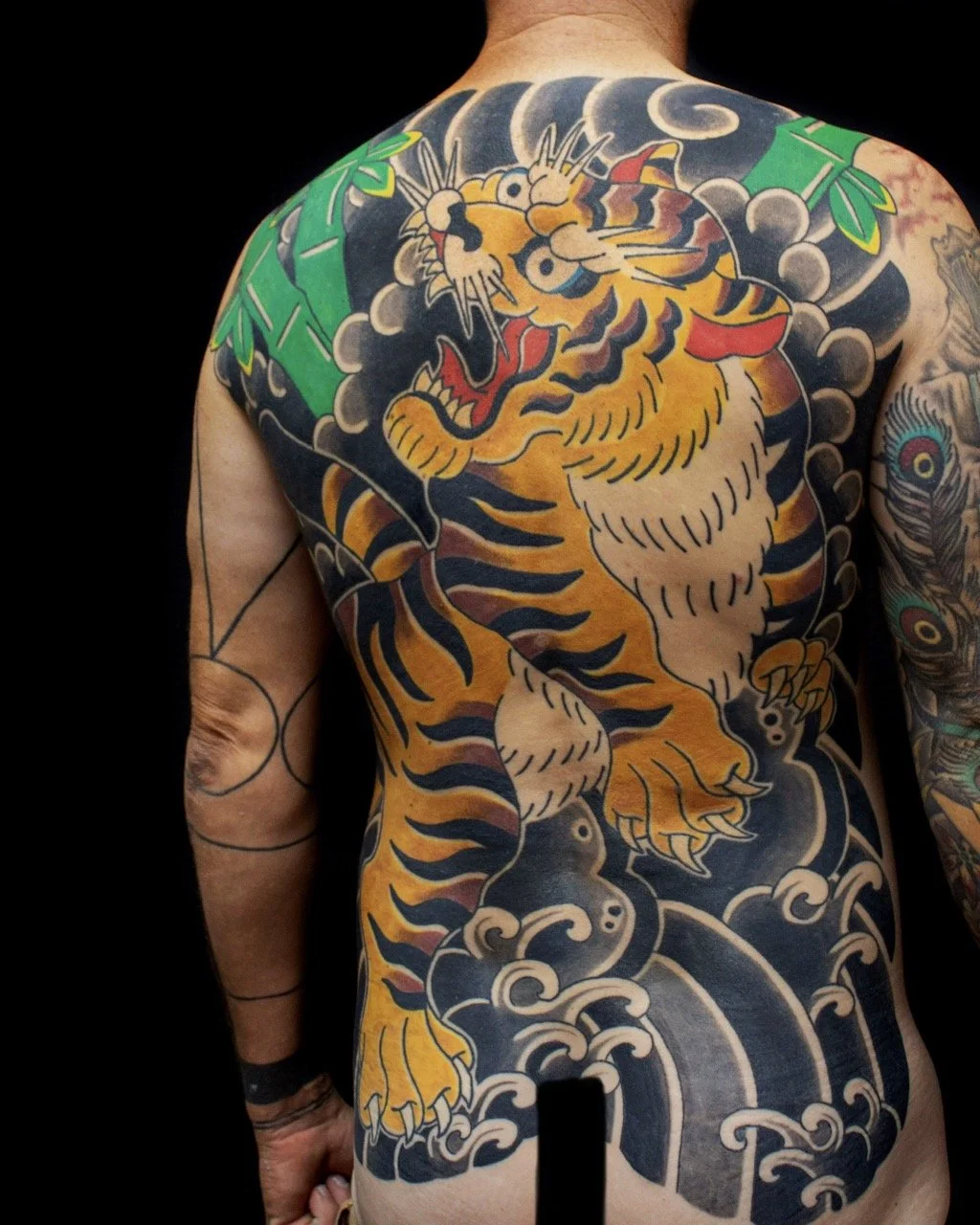
A closer view of the tiger, bamboo and traditional Japanese background wrapping around the body. Cloud and wind background on the top of shoulders transitioning down to rocks and water.
Why are tigers and bamboo often combined?
Tiger and bamboo are an established subject in East Asian and Japanese art rather than simply two unrelated symbols placed together.
In Japanese painting, the tiger is particularly associated with bamboo groves. A tiger in a bamboo grove can represent a peaceful and harmonious society, while also conveying strength and strong leadership.
There is also an interesting connection between the tiger and wind. In the traditional East Asian visual language of the tiger and dragon, the tiger is associated with wind while the dragon is associated with clouds and water. Japanese artists developed their own versions of these established motifs, with bamboo often helping to visually describe the movement of wind around the tiger.
For a Japanese tattoo, this combination works particularly well because the symbolism and composition support each other. The tiger provides the focal point, while bamboo, clouds and wind create the environment around it.
This particular backpiece
This backpiece is designed to give the impression of the tiger making its way through a river or stream, with the surrounding background changing as it moves down the body.
Across the shoulders, the background is made up of cloud and wind, creating movement around the tiger and framing the upper part of the composition. As the design travels down the back, the background gradually transitions into rock and water, bringing the scene closer to the river below.
The rocks help establish the environment, while the water bars break against them to create splashes and movement. These splashes then flow into the stylised water waves, sometimes referred to as finger waves in Japanese tattooing. Rather than simply filling the lower part of the back, the waves help continue the direction of the composition and make the tiger feel as though it is actually moving through the water.
The tiger itself is positioned in a classic climbing stance, with its body moving diagonally across the back as though it is crossing the rocks and water. This gives the design a sense of movement rather than making the tiger feel static against the skin.
The original intention for this piece was to continue the background below the buttocks, following the traditional structure of a Japanese backpiece. However, the piece was completed within the time available, and the client already had existing tattoos on the legs, so extending the design further down wasn’t practical.
Although the stopping point is different from how I would traditionally finish a full Japanese backpiece, the existing composition still allows the tiger, rocks and water to read as one scene, with the background changing from wind and clouds above to rocks and water below.
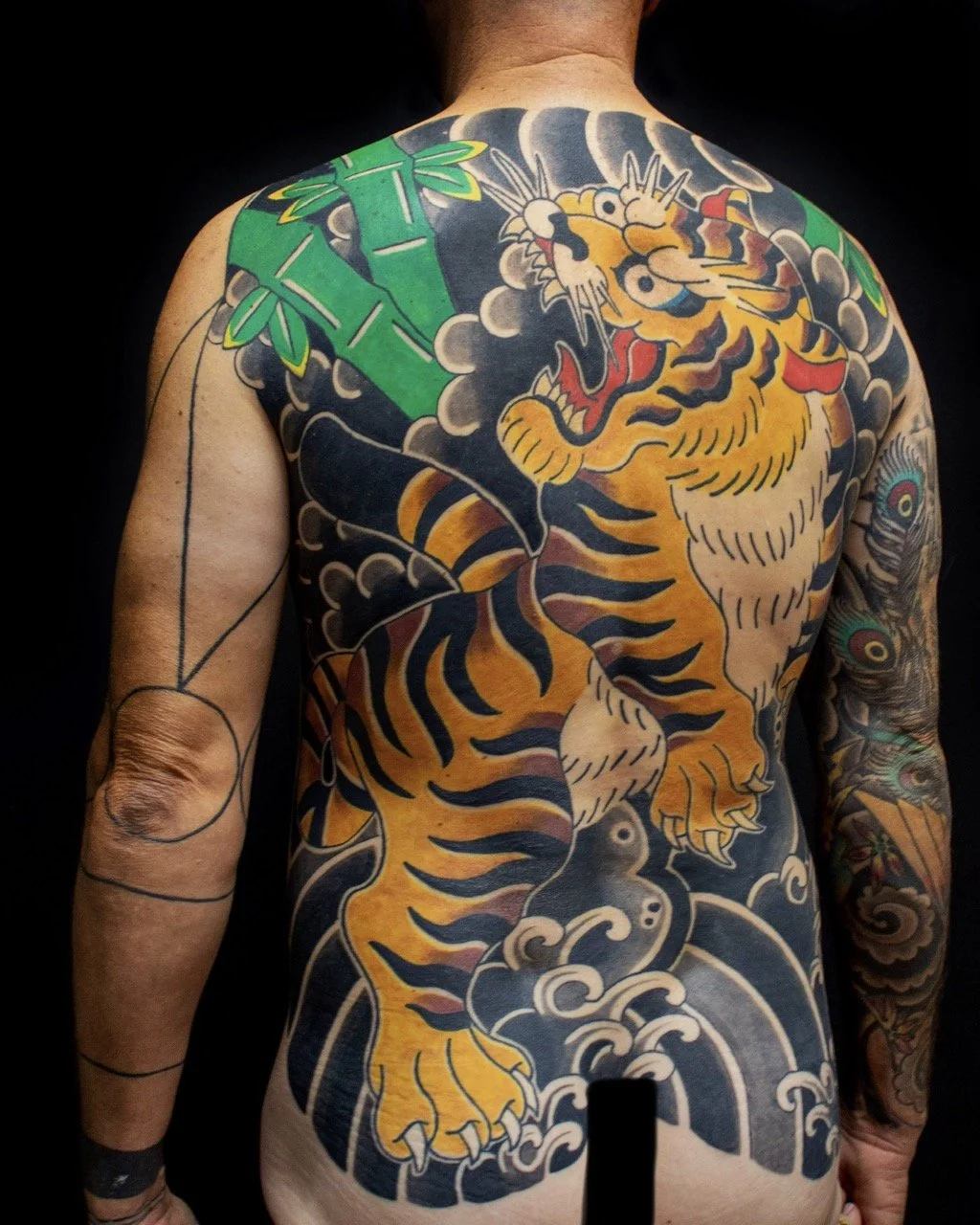
Side view showing the tiger’s climbing pose amongst the rocks and water, the flow of bamboo, clouds and wind across the back.
Why Japanese BACK PIECES traditionally extend below the buttocks
One of the biggest differences between a traditional Japanese backpiece and a conventional “back tattoo” is where the composition finishes.
A traditional full-back Japanese tattoo is designed to continue below the lower back and onto the buttocks and upper thighs. This creates a much larger continuous canvas and allows the background to maintain its flow rather than ending abruptly at the natural crease of the lower back.
From a compositional point of view, this additional coverage makes a significant difference.
The lower back naturally becomes wider toward the hips before narrowing again around the buttocks and upper thighs. Continuing the background into this area allows the design to follow those changes in the body rather than creating a hard horizontal stopping point.
It also gives the main subject more visual weight. The background has room to breathe around the figure, and the lower section of the composition can taper and flow naturally with the body.
This is one of the reasons a traditional Japanese backpiece can look so powerful when viewed as part of a larger bodysuit. The tattoo isn’t designed as an isolated rectangle on the back; it is designed around the body.
Japanese Tiger Tattoos in Auckland
A Japanese tiger backpiece is a large-scale project that requires careful consideration of the subject, background, placement and how the design will eventually sit on the body.
I specialise in Traditional Japanese Irezumi and large-scale Japanese tattoo compositions in Auckland, with a focus on strong composition, clarity and backgrounds that work with the natural shape of the body.
If you’re considering a Japanese tiger tattoo, tiger and bamboo tattoo, or a larger Japanese backpiece, you can view more of my work and enquire through my website here.
Thank you for reading.