There are some subjects in traditional Japanese tattooing that immediately capture my attention because of the story, the composition and the way they can be translated onto the body. Mongaku Shōnin beneath the Nachi Waterfall is one of those subjects. It is an image I have become particularly fascinated by, and one I would love to eventually create as a full Japanese Irezumi backpiece. The combination of Mongaku’s story of repentance and endurance with the immense movement of the waterfall creates an incredibly powerful composition, one where the water can flow from the shoulders, around the figure and down through the entire back.
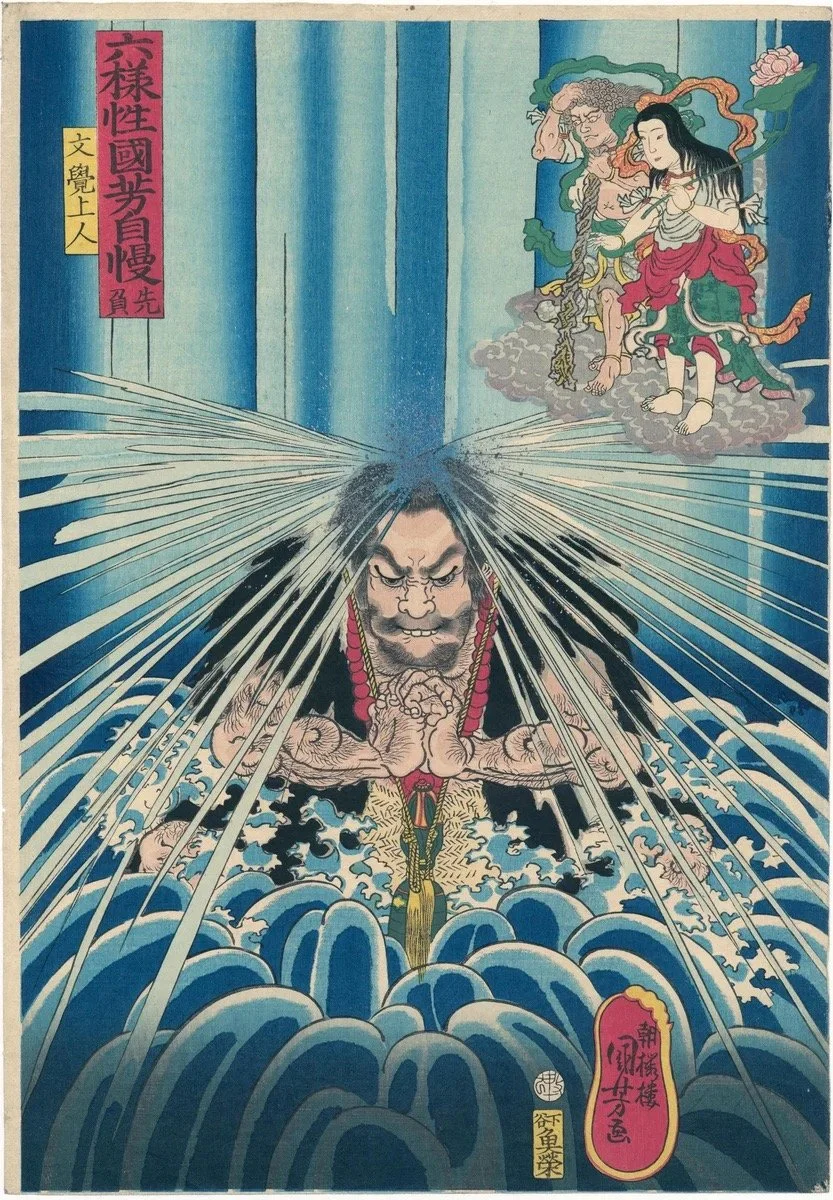
Utagawa Kuniyoshi, Mongaku Shōnin Beneath the Nachi Waterfall, from Rokuyōsei Kuniyoshi Jiman, 1860. Mongaku endures his penance while Fudō Myōō and his attendants appear above.
Who was Mongaku Shōnin?
Mongaku Shōnin was a real historical figure who lived during the late Heian period.
Before becoming a Buddhist monk, he was known as Endō Moritō, a samurai.
His story is a tragic one.
Moritō became obsessed with a woman named Kesa Gozen, who was married to another samurai. According to the traditional story, Kesa devised a plan that would allow Moritō to kill her husband. However, she secretly placed herself in her husband’s position so that Moritō would kill her instead.
In the darkness, Morito struck the fatal blow, only to discover that he had killed Kesa.
Overcome with remorse, he abandoned his former life as a warrior, became a Buddhist monk and took the name Mongaku.
His transformation from samurai to ascetic became one of the defining parts of his legend.
Mongaku beneath the Nachi Waterfall
Seeking atonement, Mongaku travelled to Nachi Waterfall, or Nachi no Taki, in Kumano.
There he undertook an extreme form of Buddhist austerity.
He stood beneath the freezing waterfall, praying and reciting Buddhist incantations to Fudō Myōō, the Immovable Wisdom King.
The traditional story tells that Mongaku endured beneath the waterfall for 21 days.
By the end of his ordeal, the freezing water had pushed him to the point of death.
It is at this moment that the supernatural enters the story.
Fudō Myōō appears with his attendants, Kongara-dōji and Seitaka-dōji, rescuing Mongaku from the freezing torrent and allowing him to complete his period of penance.
The scene became an enduring subject in Japanese art, appearing in ukiyo-e, kabuki and other forms of Japanese visual culture.
One of the most famous representations is Utagawa Kuniyoshi’s dramatic triptych of Mongaku beneath the Nachi waterfall, created around 1851–1853.
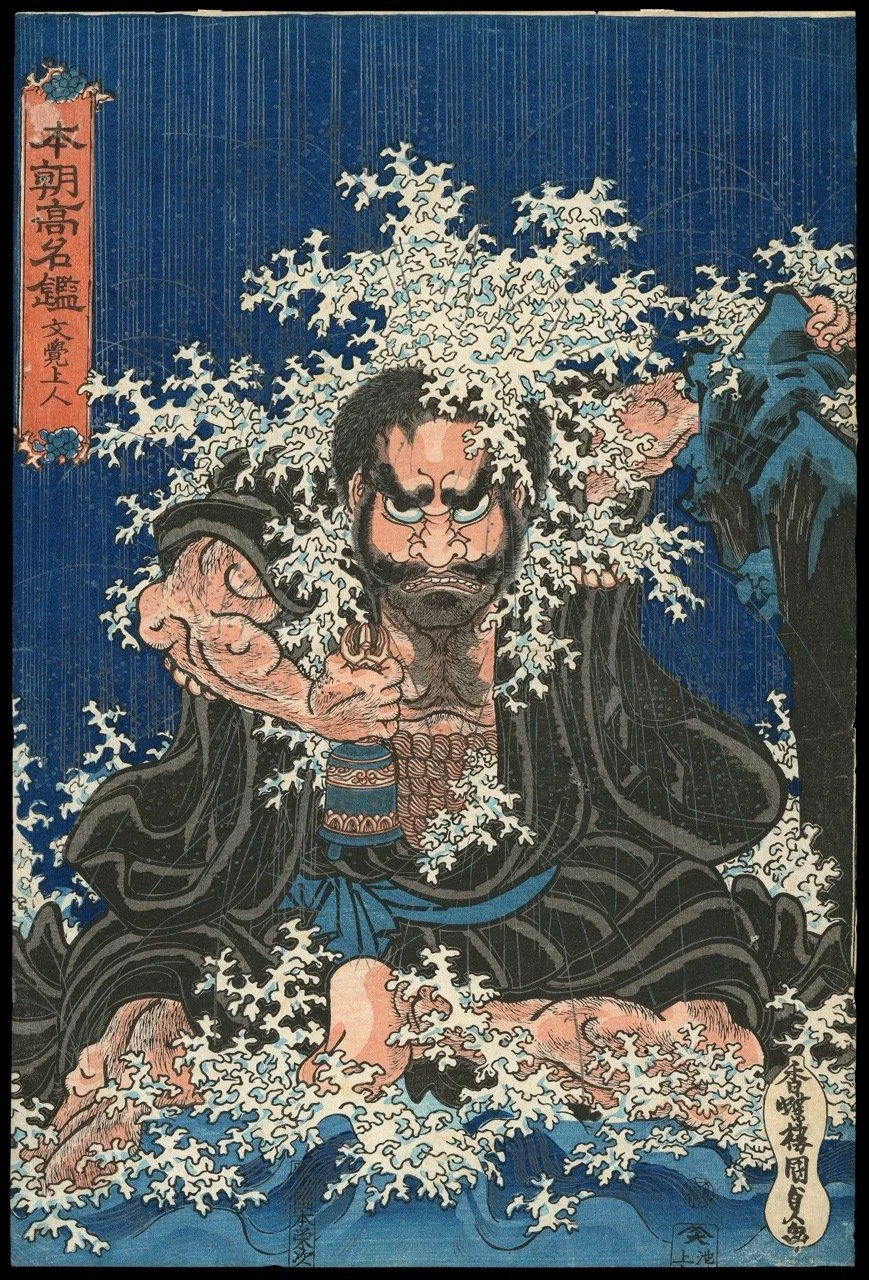
Utagawa Kunisada, Takao no Mongaku: Kii no Kuni Nachizan Ōtaki Gōmori Taigan Aragyo no Zu, c. 1847–1852. Mongaku’s legendary austerities beneath the Nachi Waterfall.
What does Mongaku Shōnin represent?
For me, the most powerful part of the story is that Mongaku isn’t simply a symbol of physical strength.
He represents endurance, remorse, discipline and transformation.
He begins his story as a samurai who commits a terrible act. Rather than running from what he has done, he turns toward an extremely difficult path of atonement.
The waterfall becomes a physical representation of that struggle. There is no comfort beneath it.
The water is freezing. The force is relentless. Mongaku remains there, still and determined, while the waterfall continues to crash over him.
That contrast between stillness and movement is what makes the image so powerful.
Mongaku remains centred and unmoving while everything around him is in motion.
The importance of the waterfall for a japanese BACK PIECE
The water isn’t simply scenery. It is the entire force of the composition.
This is one of the reasons I think Mongaku translates so beautifully into a Japanese backpiece.
The human body provides a naturally vertical canvas, and the waterfall can follow that same vertical movement.
For a full backpiece, I would want the waterfall to begin high around the shoulders and then travel down through the entire composition.
The water could start as a powerful torrent behind Mongaku before breaking around his body, flowing down towards the lower back and eventually becoming turbulent water, spray and movement.
Rather than treating the waterfall as something behind the figure, I would use it to connect the entire tattoo together.
The water creates the movement. Mongaku creates the stillness. The spine becomes the centre line holding the two together.
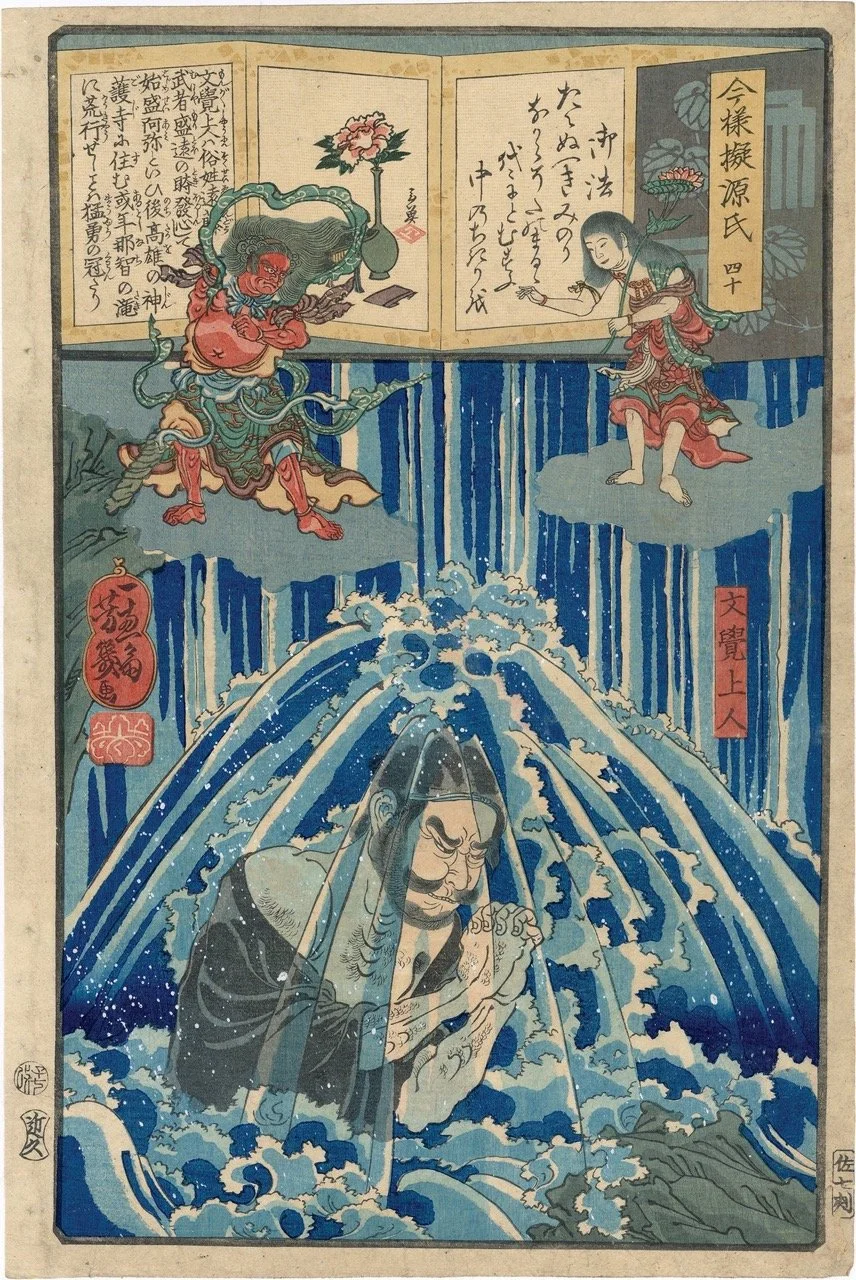
Utagawa Yoshiiku (Ochiai Yoshiiku), Mongaku Shōnin, from the series Imayō Nazorae Genji (今様擬源氏), 1864.
Why Mongaku is such an interesting Japanese tattoo subject
Mongaku Shōnin isn’t a subject you see nearly as often as dragons, koi, tigers or Fudō Myōō.
And that’s part of what makes it so interesting.
There is something special about choosing an image that isn’t immediately recognisable to everyone.
A Mongaku backpiece gives you the opportunity to have a tattoo with a deep connection to Japanese history, Buddhist imagery and traditional ukiyo-e while still being relatively uncommon.
The subject also gives a large-scale Japanese tattoo artist an incredible amount to work with, the figure, the waterfall, rocks, waves, movement, negative space and potentially Fudō Myōō and his attendants.
It can be designed as a complete story rather than simply placing a character onto the back.
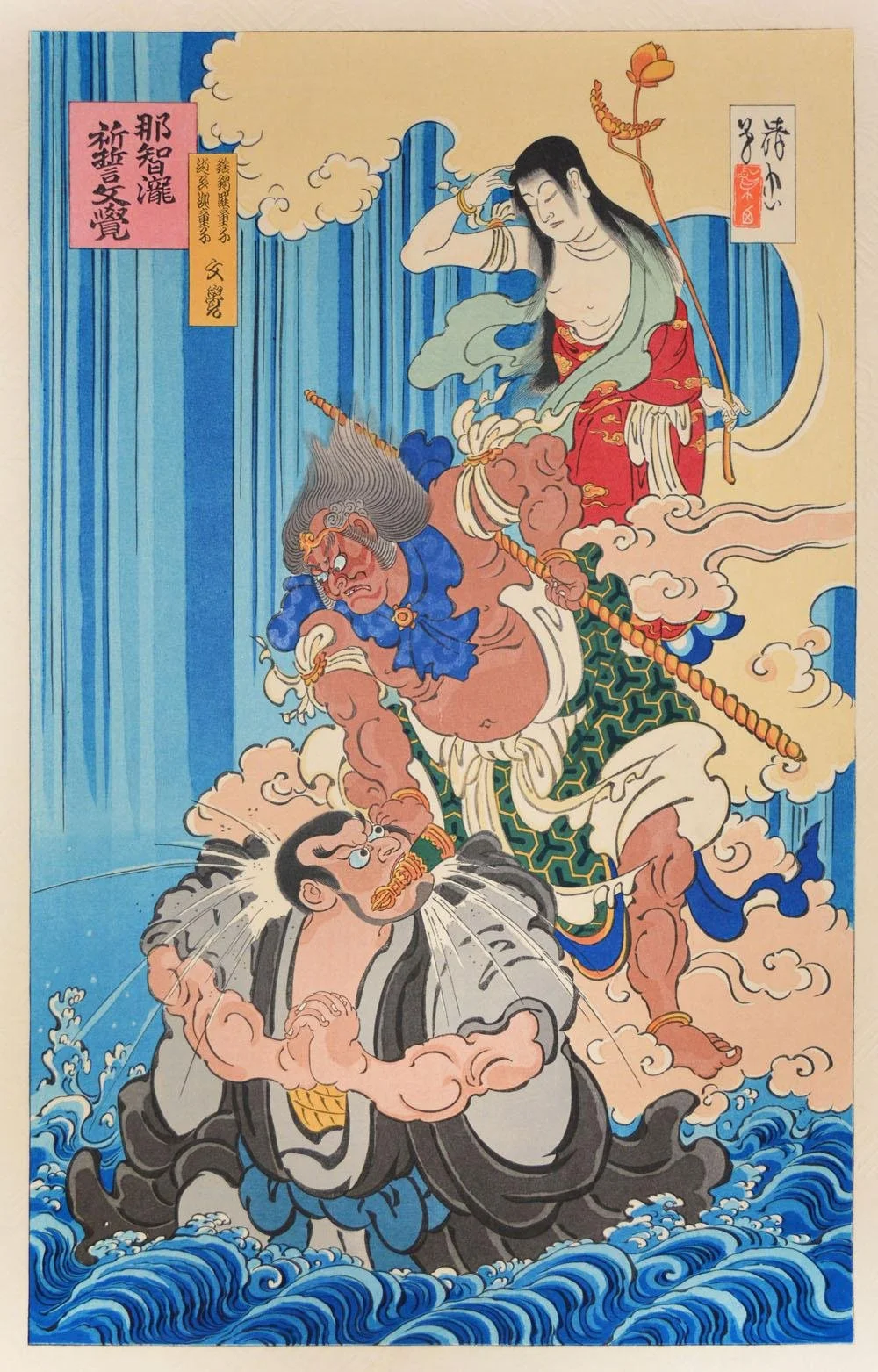
Morikawa Chikashige, Nachi no Taki Chikai no Mongaku (Mongaku at Nachi Waterfall), 1883.
A backpiece I’d love to create
Mongaku Shōnin is a subject I would genuinely love to tattoo as a full backpiece. It is not an image I see requested often, which makes it particularly exciting to me as a tattoo artist.
I love the strength and intensity of the original ukiyo-e prints, and there is so much potential to develop the subject into a large-scale Irezumi piece while staying true to its traditional roots.
For someone looking for a Japanese backpiece with a strong story and a less commonly seen subject, Mongaku Shōnin would be an incredible choice. If this is a piece you can see yourself wearing, get in touch to discuss your ideas and book a consultation. I would love to create my own interpretation of Mongaku Shōnin as a full Japanese Irezumi backpiece.
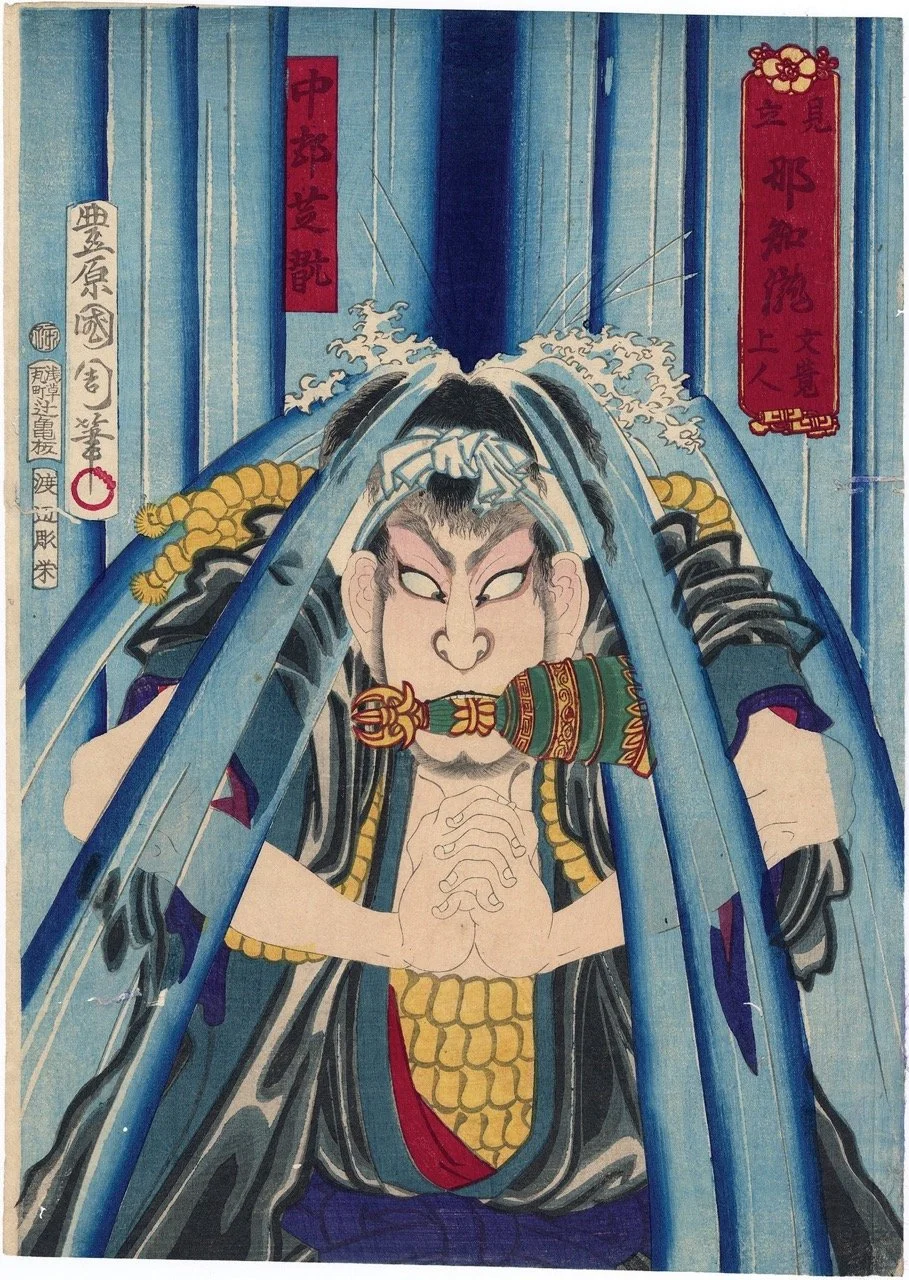
Utagawa Kuniyoshi, “Mongaku Shōnin Under the Waterfall of Nachi,” c. 1851.