Crane, Koi & Sakura Japanese Irezumi Sleeve
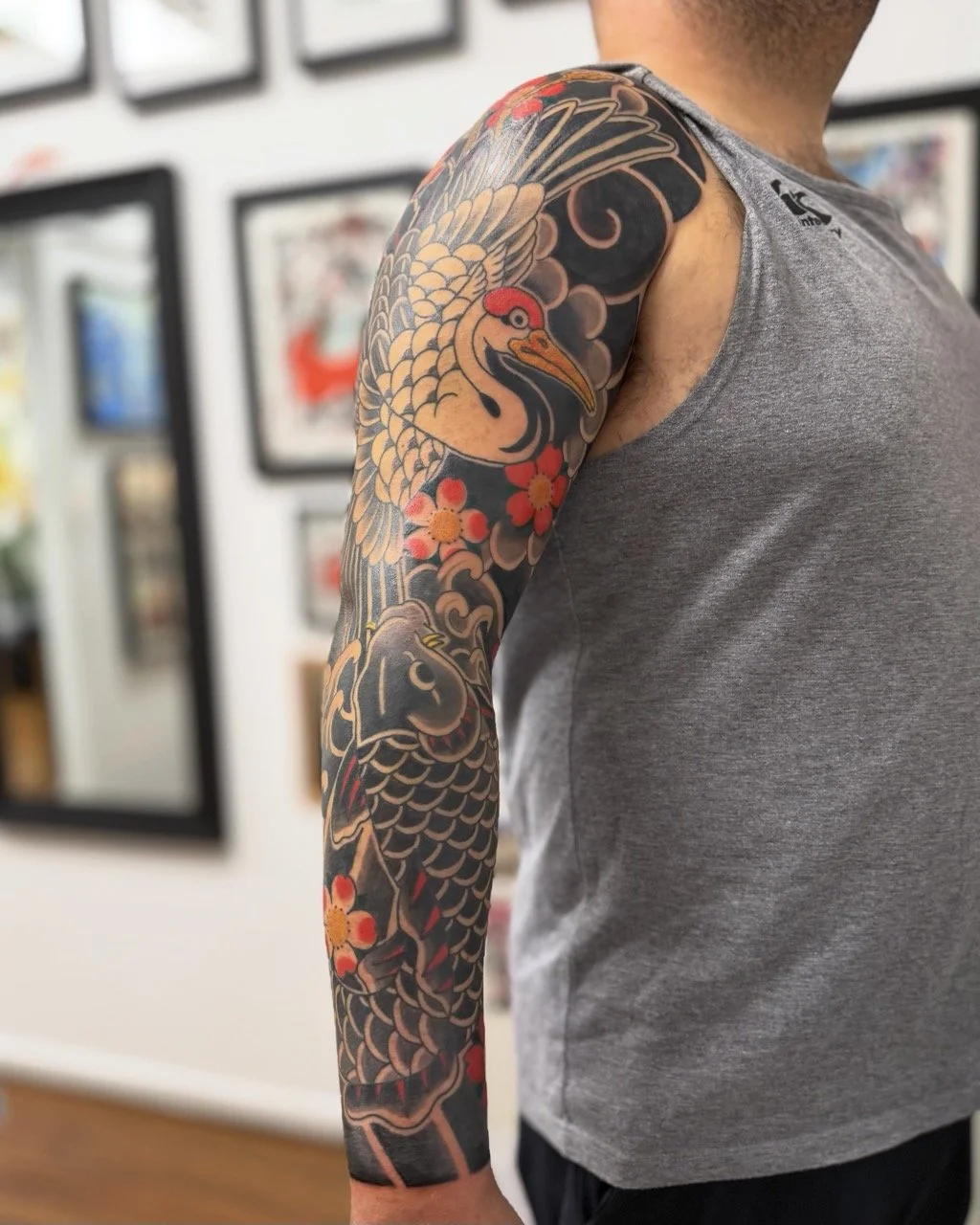
Traditional Japanese crane and koi sleeve tattoo by Horiyama in Auckland, New Zealand
This full Japanese sleeve brings together a crane, koi, sakura (cherry blossom), water and wind in a traditional Japanese irezumi composition, using a muted colour palette of black, grey, skin tone and restrained red.
My client travelled up from Nelson to Auckland to have this sleeve completed. We began with an initial consultation over the phone, discussing the subject matter, placement, composition and overall feeling he wanted for the tattoo before beginning the sessions.
The finished sleeve took six full-day sessions to complete. My client was absolutely amazing throughout the process and sat like a rock from beginning to end. Thank you for all the fun chats and laughs along the way 😄 It was such a pleasure working on this piece with you!
The tattoo is freshly completed in these photographs, so I’m particularly looking forward to seeing how the colours and contrast settle once the sleeve has fully healed.
Crane, Koi and Sakura
The main subjects of this Japanese tattoo are a crane and koi, surrounded by sakura and traditional Japanese background.
The crane occupies the upper arm and shoulder, with its wings extending across the shoulder to create a strong sense of movement and openness. In Japanese tattooing, the crane (tsuru) is associated with longevity, good fortune and a long life, making it a beautiful subject for a large-scale tattoo.
The koi moves through the lower section of the sleeve, creating a very different feeling to the crane above it. Where the crane has an upward, expansive movement, the koi follows the shape of the arm and gives the lower half of the sleeve weight and direction.
Koi are one of the most recognisable subjects in Japanese tattooing and are traditionally associated with qualities such as strength, determination, perseverance and transformation. The movement of the koi through the water also gives the sleeve a natural flow rather than making the main subjects feel like separate images placed next to one another.
Sakura blossoms are worked throughout the sleeve, bringing a softer element to the composition. Their delicate shape contrasts with the heavier black background, scales and flowing wind and water. It allows bursts of colour in amongst the dark background.
The combination of crane, koi and sakura gives this sleeve a balance of strength and grace, movement and stillness, water and sky.
Water Transitioning Into Wind and Cloud
One of the parts of this sleeve I particularly enjoyed was the background.
At the lower part of the arm, the composition begins with water surrounding the koi. As the eye moves upwards, the background gradually transitions into wind and cloud around the crane.
This helps establish a sense of environment for the two main subjects rather than simply using background as filler.
The koi belongs naturally within the water, while the crane occupies the upper part of the composition amongst the wind and clouds. The transition between the two creates a continuous flow around the arm.
This type of background, or gakubori, is an important part of traditional Japanese tattoo composition. Rather than treating the background as something added after the main image, I design it together with the subject from the beginning so that everything works as one piece.
The background also helps control the amount of negative skin space throughout the sleeve and gives the main imagery enough contrast to remain clear.
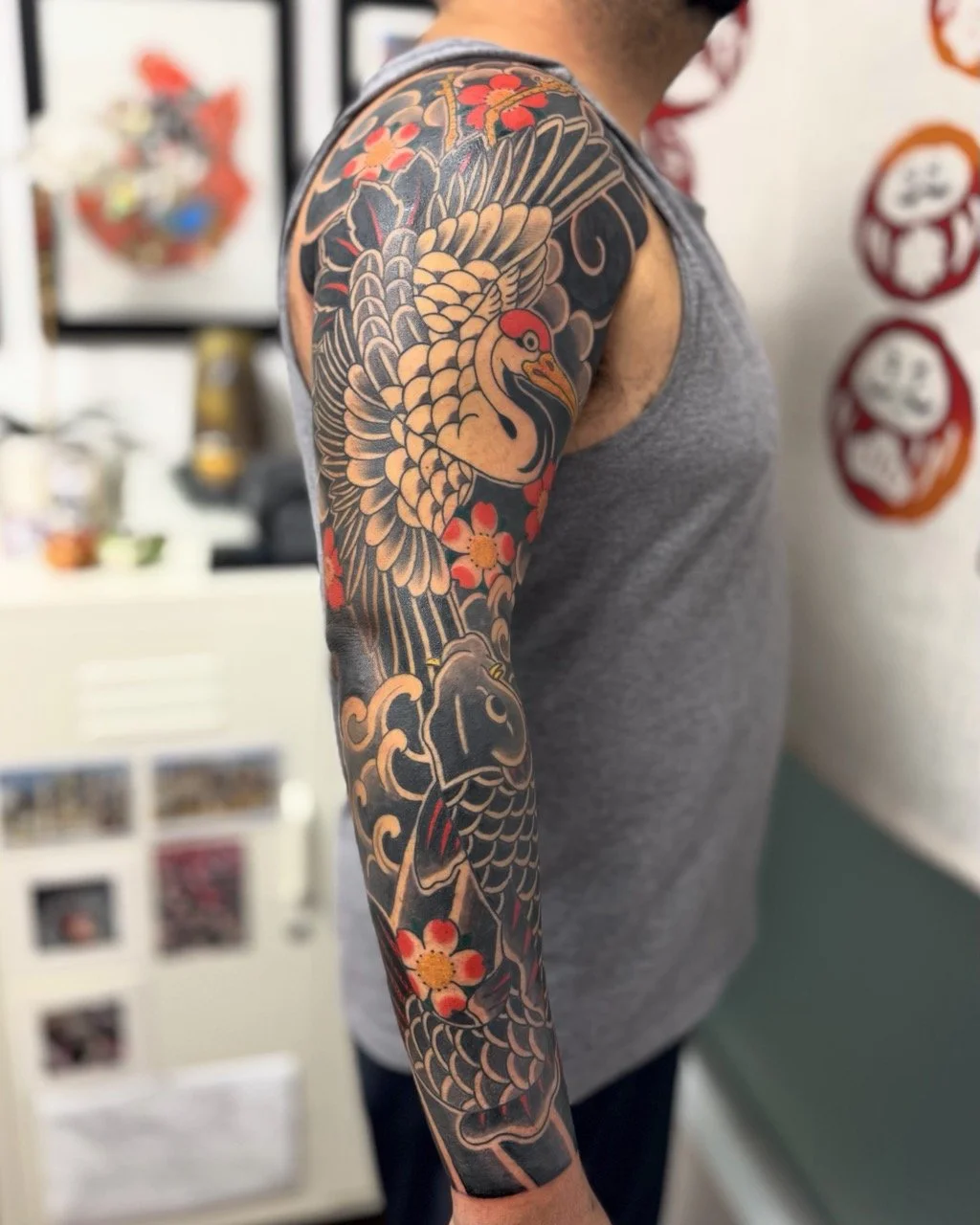
Japanese Irezumi full sleeve featuring crane, koi, sakura, water and wind
A Muted Japanese Tattoo Colour Palette
For this sleeve, my client wanted to kept the colours relatively muted rather than using a bright, highly saturated palette.
The main foundation is made up of black, grey and warm neutral tones, with red used selectively throughout the sakura and smaller details.
I really enjoy working with this type of restrained colour palette because it allows the composition, linework and shading to do much of the work.
The red becomes more noticeable because it isn’t competing with lots of other strong colours. The sakura therefore act as small points of colour throughout the sleeve, drawing the eye around the arm without overpowering the crane and koi.
The result is a Japanese sleeve that has colour, but still retains a strong, traditional and slightly understated feeling.
Six Full-Day Sessions
The first part of the tattoo was completed through the initial lining sessions.
My client travelled from Nelson, so we organised the sessions in a way that made the trip to Auckland worthwhile. After completing the initial lining, we then worked through two full days of shading back-to-back.
For some clients, doing two shading sessions on consecutive days can be quite manageable. Because I work on different sections of the arm during each session, I’m able to move around the sleeve rather than repeatedly working over exactly the same area.
Of course, everyone’s tolerance and healing is different, so consecutive sessions aren’t suitable for everyone. But when a client is comfortable with it, it can be a really efficient way of progressing a large Japanese tattoo.
Altogether, this full Japanese sleeve took six full-day tattoo sessions.
And I couldn’t have asked for a better client. He sat incredibly well throughout the entire process.
A Small Detail With a Very Special Meaning
There is one part of the tattoo that unfortunately isn’t shown in these photographs.
We also added a small goldfish (kingyo) on the inner arm to represent the baby my client had on the way.
I really like details like this in Japanese tattooing. The larger composition can be built around traditional imagery and structure, while smaller elements can hold a very personal meaning for the person wearing the tattoo.
It’s something that might not immediately be obvious to someone looking at the finished sleeve, but it gives the tattoo another layer of personal significance.
Looking Forward to Seeing It Healed
These photographs were taken immediately after completing the sleeve, so the tattoo is still very fresh.
Fresh Japanese tattoos can look considerably darker and more saturated than they will once healed. I’m especially interested to see how the muted colours, black background and warm tones settle into the skin.
One of the things I enjoy most about doing large-scale Japanese tattooing is seeing the difference between a freshly completed tattoo and the same piece once it has healed and settled.
The structure of this sleeve should become even clearer as the skin settles, particularly the contrast between the crane, koi and the surrounding water, wind and cloud.
I’m really happy with how this one came together, and I’m looking forward to seeing the healed result.
Done by Horiyama — Auckland, New Zealand.
I specialise in Traditional Japanese Irezumi, Japanese sleeve tattoos and large-scale Japanese tattooing, with a focus on strong composition, clear imagery and traditional Japanese background.
If you’re considering a Japanese tattoo in Auckland or New Zealand, you can get in touch to discuss your ideas, placement and the type of Japanese tattoo you’re interested in.
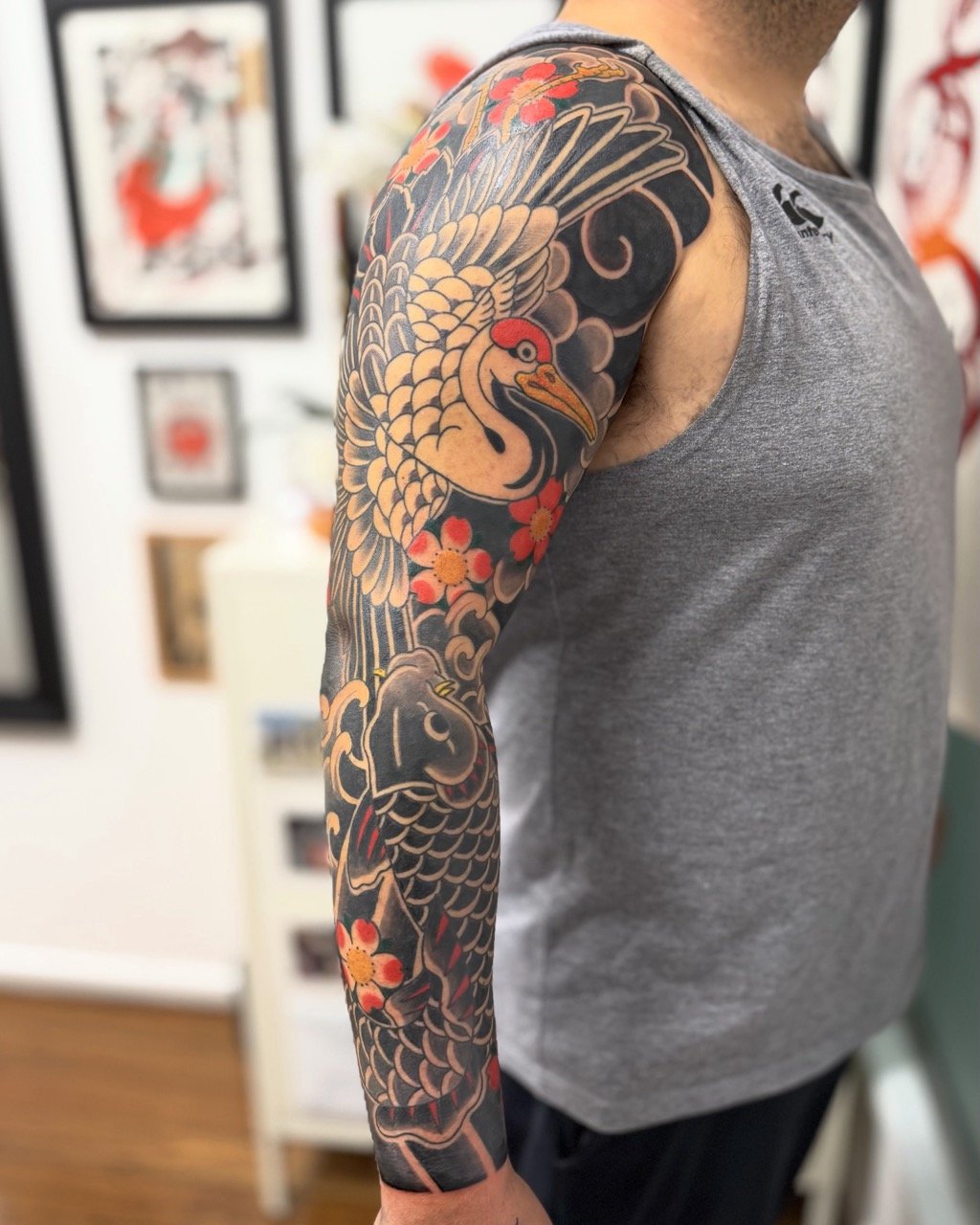
Traditional Japanese koi and crane sleeve tattoo with muted colours and sakura