Shōki the Demon Conqueror: His Story, Symbolism and Place in Traditional Japanese Tattooing
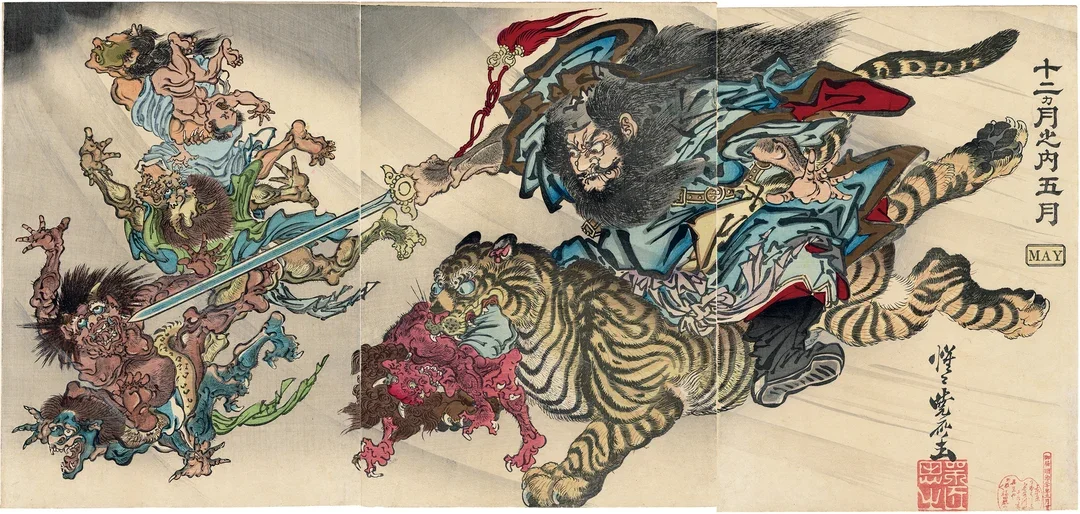
Kawanabe Kyosai 1887
Shōki, often known as the Demon Queller or Demon Conqueror, is a subject I particularly enjoy tattooing.
He isn’t one of the most commonly requested figures in traditional Japanese tattooing, which is part of what makes him interesting. Unlike the samurai, dragons, koi and tigers that are more immediately recognisable as Japanese tattoo subjects, Shōki has a very distinctive appearance and a story that has travelled across cultures.
With his long robes, large beard, fierce expression and sword, he has a strong presence. He can be tattooed as an imposing and serious figure, but he also lends himself incredibly well to compositions involving mischievous oni doing everything they can to escape him.
His history is also fascinating. Although Shōki became an important figure in Japanese art and culture, his story originally comes from China.
The Story and Origin of Shōki
Shōki (鍾馗) is the Japanese version of the Chinese figure Zhong Kui.
His story dates back to the Tang dynasty in China. According to legend, Zhong Kui was a scholar who attempted to succeed in the imperial examinations. After his death, he appeared in a dream to the Emperor Xuanzong.
In the dream, a small demon was causing trouble within the imperial palace. Zhong Kui appeared, captured the demon and destroyed it, revealing himself as a spirit who had vowed to rid the world of troublesome demons.
When the emperor awoke, his illness had disappeared. He commissioned an artist to paint the figure he had seen in his dream, helping establish Zhong Kui as a protective figure associated with defeating demons and warding off evil.
The story and imagery eventually travelled to Japan, where Zhong Kui became known as Shōki.
In Japan, Shōki became associated with protection from evil, illness and misfortune. His image was particularly connected with protecting children and became an important figure around the Boys’ Festival, now celebrated as Children’s Day.
Shōki’s protective role is one of the reasons his image became so popular in Japanese art. He isn’t simply a warrior fighting an enemy; he represents the act of confronting and overcoming harmful forces.
Shōki’s Clothing and Appearance
One of my favourite things about tattooing Shōki is his clothing.
His robes and headwear are quite different from many of the warriors and heroes commonly depicted in Japanese tattooing. Shōki is generally shown wearing the clothing of a Chinese scholar or official, reflecting the Chinese origins of his story.
His long robes provide a lot of opportunity to create movement within a tattoo. Sleeves can twist and sweep around the body, while folds in the fabric can emphasise the direction and force of the scene.
He is also usually depicted with his characteristic large beard, heavy eyebrows, intense expression and sword. Together, these elements give Shōki a silhouette that is immediately recognisable.
His clothing also gives the design a different visual quality from the armour, bare skin and weapons often associated with Japanese warrior imagery. There are large areas of fabric to work with, making the direction of the folds and the way the robes sit around the body an important part of the composition.
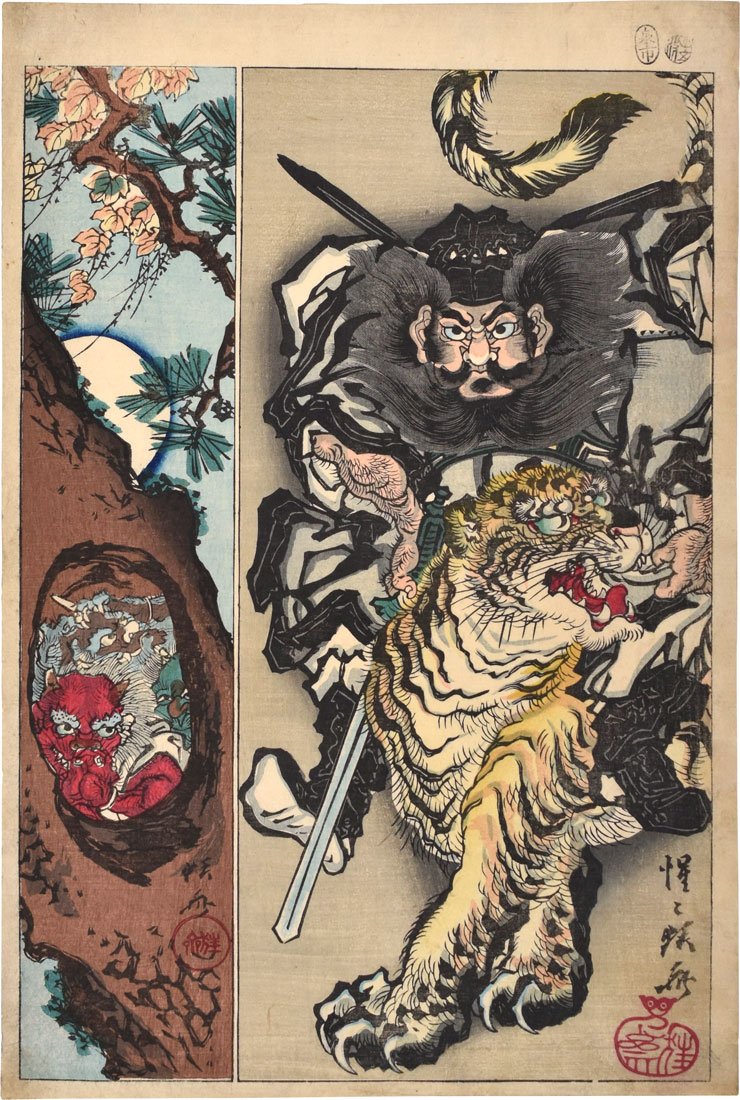
Kawanabe Kyosai 1831-1889. Shoki Riding a Tiger; Demons Hiding in a Pine Tree
Shōki in Japanese Woodblock Prints
Shōki became a popular subject in Japanese painting and ukiyo-e woodblock prints, with artists such as Katsushika Hokusai and Utagawa Kuniyoshi producing their own interpretations of the Demon Queller.
Some of my favourite historical depictions of Shōki use extremely bold outlines. In certain woodblock prints, parts of his figure and clothing are surrounded by thick, almost painted marks that resemble strong brushstrokes.
This is something that can translate beautifully into tattooing.
A technique sometimes used to achieve this effect is double lining or deliberate line thickening, where particular sections of an outline are given significantly more weight. Rather than every line having the same thickness, the heavier areas can recreate the feeling of an ink brush pressing into paper.
Brushstroke-inspired linework is particularly effective around Shōki’s robes. It helps communicate which direction the fabric is moving, where it is folding and how much force is behind the action.
Brushstrokes are an important part of both traditional Japanese painting and tattooing. A tattoo doesn’t need to copy a woodblock print exactly. Instead, techniques found within historical artwork can be adapted to suit tattooing and stand the test of time while retaining the character and energy of the original imagery.
Shōki and the Oni
As the Demon Conqueror, Shōki is often seen surrounded by oni. This is probably my favourite part of designing a Shōki tattoo.
The oni don’t always need to be portrayed as terrifying creatures. They can be frightened, angry, mischievous or simply trying their best to get away from Shōki.
You can have one hiding behind him, another being grabbed by the beard, or smaller oni scrambling in different directions as Shōki hunts them down.
These little interactions can add a lot of personality to a larger Japanese tattoo composition. They also create opportunities for humour without taking away from the strength of the main figure.
Shōki remains the dominant character, while the oni help tell the story around him.
Why Does Shōki Have a Tiger?
Shōki is sometimes depicted alongside or riding a tiger, although the tiger isn’t actually a central part of the original Zhong Kui legend.
Rather than being an essential companion to Shōki, the tiger became part of later artistic interpretations of the figure.
The pairing works particularly well symbolically. Tigers have long held associations with strength, courage and protection in East Asian art, making them a natural visual companion for a figure whose purpose is to defeat evil and protect against harmful forces.
From a tattooing perspective, the combination also creates an incredible opportunity for a large-scale composition. Each element has a different shape and character, allowing the entire piece to feel like a complete scene rather than simply a portrait of one figure.
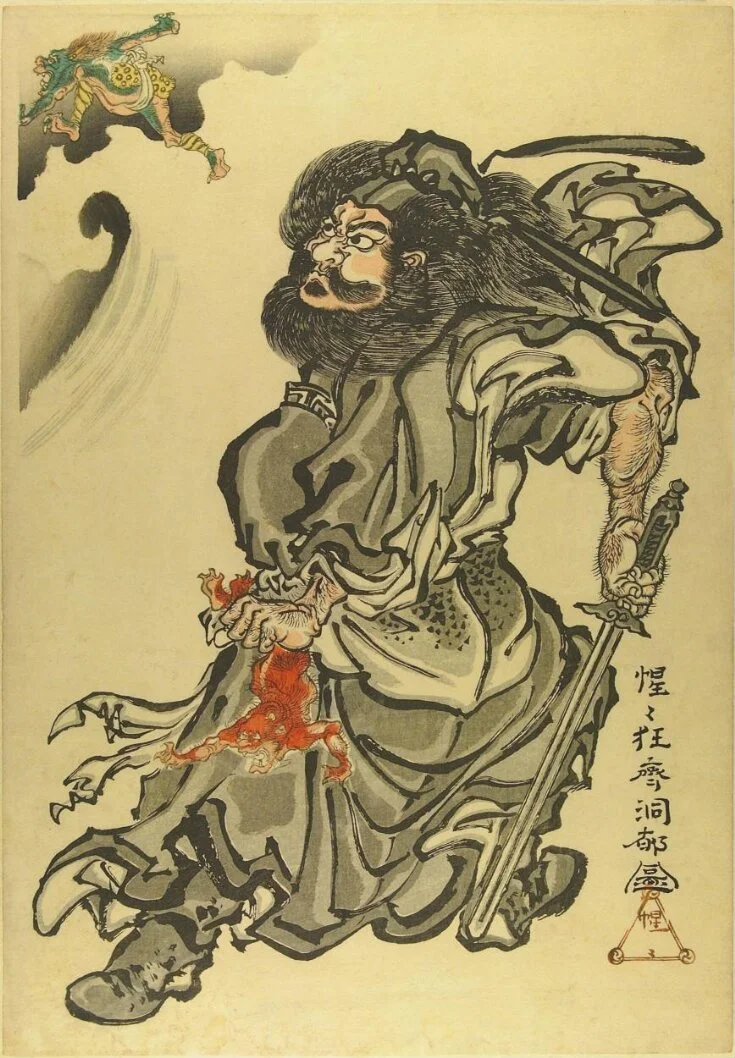
Shoki and demons - Kuniyoshi
Why I Enjoy Tattooing Shōki
Shōki is one of those subjects where the historical artwork gives you a lot to work with while still allowing room for creativity.
His unusual clothing, strong facial features and exaggerated beard create an immediately recognisable figure. The robes allow for dramatic movement, while the sword and surrounding oni can be used to create a strong narrative within the composition.
I particularly enjoy referencing old woodblock prints when working on these designs. Looking at how an artist used a brushstroke to describe a fold of fabric or the movement of a character can influence how that same idea is translated into tattoo linework.
The result doesn’t need to be a direct reproduction of an old print. The goal is to take those visual ideas and reinterpret them for the body.
For me, that’s one of the most interesting parts of traditional Japanese tattooing — the connection between historical artwork and contemporary Irezumi.
Shōki may not be one of the most common Japanese tattoo subjects, but that is exactly what makes him appealing. He offers a combination of history, protection, humour and strong visual character, with plenty of possibilities for creating a unique Japanese tattoo design.
For anyone looking for a traditional Japanese tattoo that is a little less commonly seen, Shōki is a subject with an incredible amount of personality.
Thank you for reading!