Raijin and Fujin: The Legendary Gods of Thunder and Wind
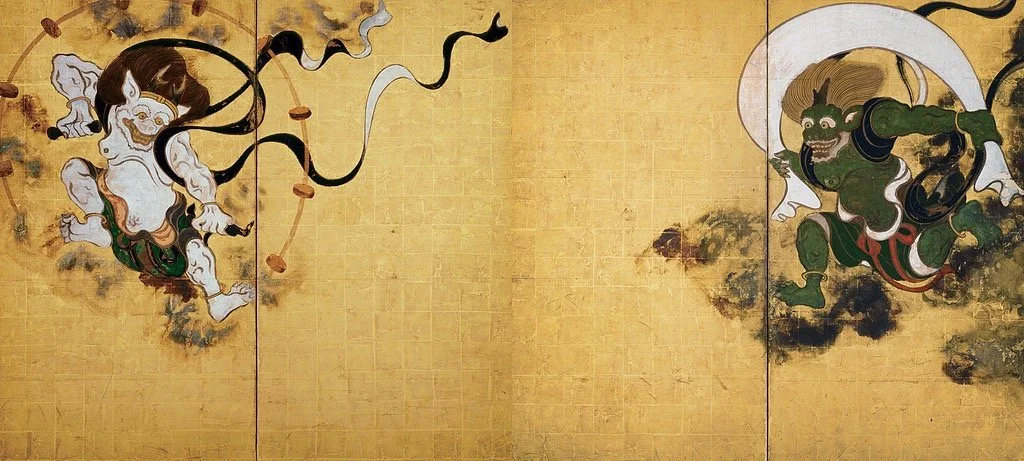
Artist - Tawaraya Sōtatsu
Raijin (雷神) and Fujin (風神) are among the most recognisable figures in traditional Japanese tattooing. Often seen together sweeping across the back, chest, or sleeves, these two deities represent the unstoppable forces of nature—thunder and wind. Their dramatic movement, expressive faces, and rich symbolism make them a timeless choice for large-scale Japanese tattoos.
But beyond their striking appearance lies centuries of history, mythology, and artistic tradition.
The Origins of Raijin and Fujin
Raijin and Fujin originate from Japanese mythology and have been part of Japanese culture for over a thousand years. Their imagery was influenced by both Shinto beliefs and Buddhism, with similar wind and thunder gods appearing throughout Asia before becoming uniquely Japanese.
One of the most famous depictions of the pair is found in the early 17th-century folding screens by artist Tawaraya Sōtatsu (see first image). These paintings helped define the appearance of Raijin and Fujin that is still recognised today and continues to inspire Japanese tattoo artists around the world.
Throughout history, people believed these gods controlled storms, rainfall, harvests, and the changing seasons. While storms could bring destruction, they also brought life-giving rain essential for growing crops. For this reason, Raijin and Fujin were both feared and respected.
Raijin – The God of Thunder
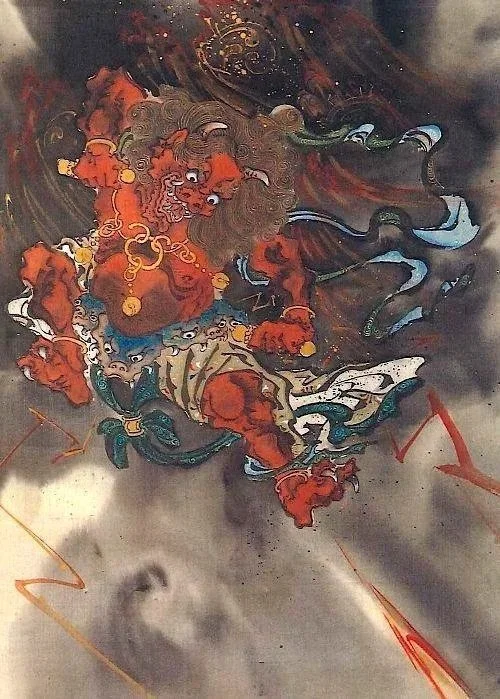
Artist - Tenugui Kawanabe Kyosai
Raijin’s name literally means “Thunder God.”
He is typically depicted as a muscular oni-like figure with fierce facial expressions, wild hair, and a powerful stance. Surrounding him is a ring of taiko drums, each decorated with the tomoe symbol. By striking these drums, Raijin creates thunder that echoes across the sky.
Many traditional depictions show Raijin carrying drumsticks used to beat the drums, while lightning crackles around him.
Despite his intimidating appearance, Raijin is not considered evil. Like many figures in Japanese mythology, he represents a force of nature that demands respect rather than fear.
Fujin – The God of Wind
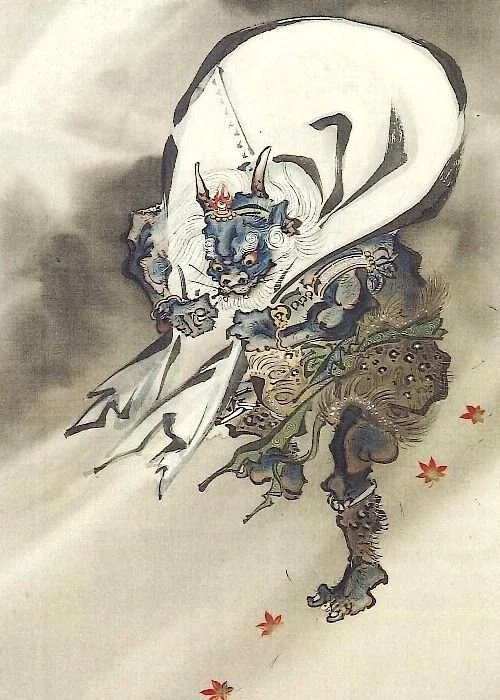
Artist - Tenugui Kawanabe Kyosai
Fujin is the God of Wind and is usually shown racing through the sky carrying an enormous sack draped across his shoulders.
Inside this great bag are the winds of the world. When Fujin opens it, powerful gusts are released, bringing gentle breezes, seasonal changes, or devastating typhoons depending on nature’s will.
His body is dynamic, often twisting dramatically as the wind swirls around him. His clothing flows with movement, making Fujin one of the most visually exciting subjects in Japanese tattooing.
An Interesting Detail: Their Feet
One of the details many people overlook is the number of toes on Raijin and Fujin.
In traditional Japanese artwork, Raijin is often depicted with three toes, while Fujin is shown with four. This is a deliberate artistic choice that carries symbolic meaning rather than simply being a stylistic preference.
Raijin’s three toes are said to represent the past, present, and future, reflecting the enduring power of thunder through time.
Fujin’s four toes symbolise the four cardinal directions—north, south, east, and west—representing the wind’s ability to travel freely across the entire world.
These distinctive features also help emphasise that Raijin and Fujin are divine beings rather than ordinary humans. Traditional Japanese tattoo artists often preserve these classical details as a way of honouring centuries of Japanese art and mythology.
Why Are Raijin and Fujin Always Together?
Although each deity can be tattooed individually, they are traditionally shown as a pair.
Wind and thunder naturally accompany one another during storms. Together they represent balance, cooperation, and the harmony of opposing forces.
Neither is considered stronger than the other. Instead, they complement one another, creating one complete image of nature’s immense power.
In Japanese tattooing, this balance is particularly important. Large compositions often tell a story, and pairing Raijin and Fujin creates movement across the body while maintaining visual harmony.
Both gods are often surrounded by swirling clouds, lightning, crashing waves, or dark skies. These background elements help create movement while reinforcing their command over the natural world.
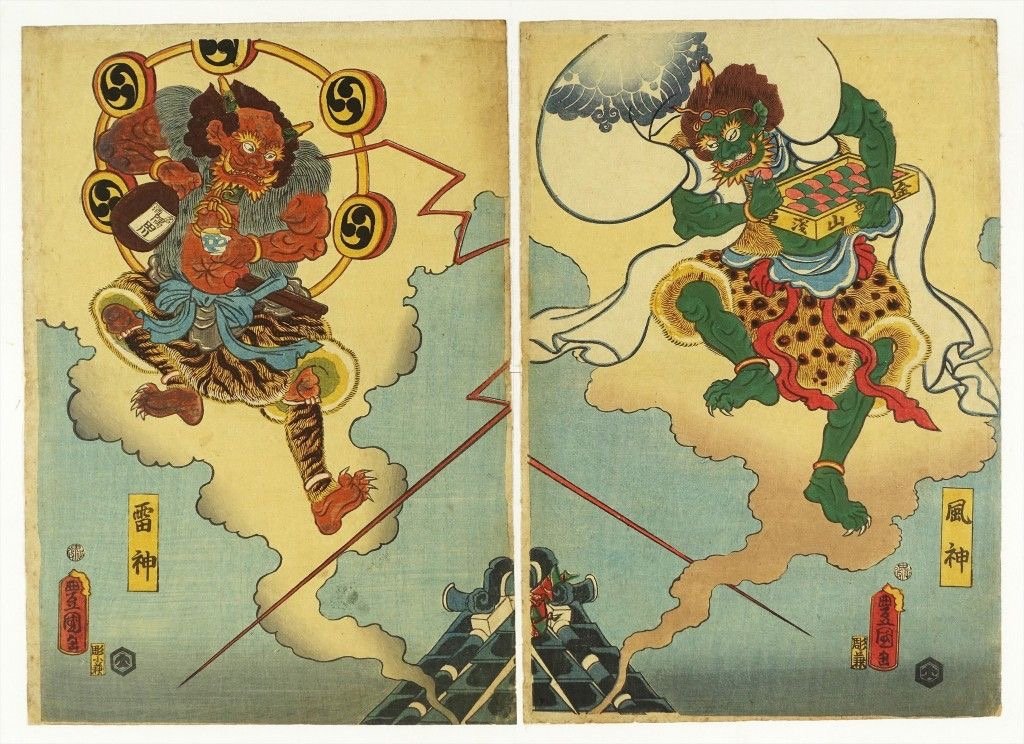
Utagawa Kunisada
The Meaning of Raijin and Fujin Tattoos
Choosing Raijin and Fujin as a Japanese tattoo can carry many personal meanings.
Some people are drawn to the idea of embracing life’s uncontrollable forces. Others see the pair as symbols of resilience through adversity, accepting both calm and chaos as part of life’s journey.
They can also represent:
Respect for the power of nature
Balance between opposing forces
Courage in the face of uncertainty
Protection during life’s storms
Personal growth through unexpected change
Raijin and Fujin in Traditional Japanese Tattooing
Raijin and Fujin have remained popular subjects for generations because they embody movement, drama, and balance. Their flowing composition works beautifully across the back, full front, and sleeves, allowing the body itself to enhance the direction of the wind and thunder.
As with all traditional Japanese tattoo subjects, these gods are more than striking imagery. They carry centuries of mythology, symbolism, and artistic tradition, making them meaningful choices for collectors who appreciate the deeper stories behind their tattoos.
Whether chosen for their symbolism or simply their powerful visual impact, Raijin and Fujin continue to stand as two of the most iconic figures in Japanese tattooing, reminding us that even the wildest storms are part of the natural rhythm of life.
Thank you for reading.